
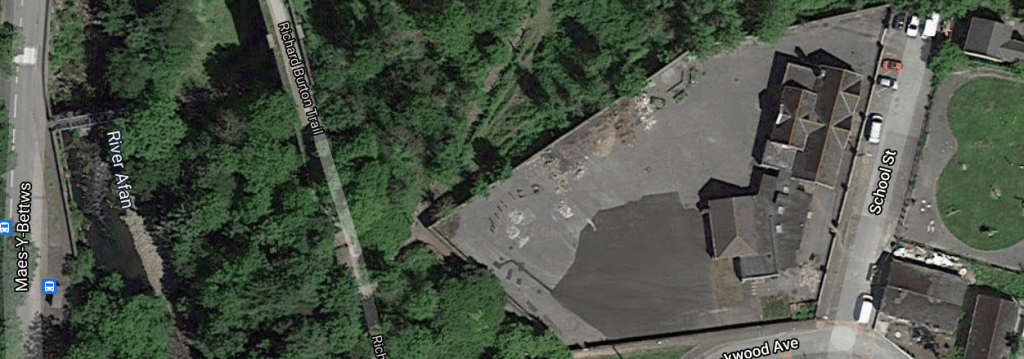
We were pleased to be involved in a planning proposal to convert the former Pontrhydyfen primary school into living accommodation for an extended family, along with the addition of some chalet-type buildings and possibly a small indoor pool in the accompanying playground, last year. The family was also very keen to include a variety of habitats in the form of some raised beds and ponds to invite wild life to share the area.
The school buildings had been empty for more than 5 years and were showing signs of decay. In addition, small piles of rubble had been left in the playground area following work on nearby properties, prior to the current client purchasing the school. We undertook a Phase 1 Habitat Survey and, because of its proximity to woodland and rivers, protected species surveys for badger and otter, as well as providing advice on preventing pollution and improving biodiversity. The deteriorating roof space had become ideal for roosting bats, so a bat survey was also required.
If you would like to see other summaries of projects we have undertaken, please browse the Our Work page of our website. If you think we could help you with ecological support of your development project, please contact us.
Phase 1 Habitat Survey. Our Phase 1 Habitat Survey, unsurprisingly, found little of any conservation value within the thick stone wall boundaries which enclosed the property, although there were several gaps and holes in the roof structure of the old school buildings. Other than the possible presence of bat roosts within the roof voids, there were therefore no habitats or species considered to be priority categories under Section 7 of the Environment (Wales) Act 2016 or protected by the Wildlife and Countryside Act 1981. At that time, we were unable to undertake the inspection of the roof voids ourselves, but this was completed successfully by other licensed ecologists soon afterwards.
Badger Surveys. Physical inspection of the habitats immediately outside the school boundaries suggested that they included suitable territory for use by badgers, although no evidence was found of setts, or any of the other field signs associated with their presence, within 30 metres of the proposed development area. The terrain within 100 metres of the proposed site was considered to be largely sub-optimal for badgers, being very steeply sloped, and visual inspection again revealed no badger field signs. Furthermore, a check of local ecological records revealed that there had been only one sighting of a badger within 2km of the proposed development site, about 18 years ago, and that had been on the other side of the River Afan, which flowed steeply downhill nearby. It was therefore concluded that the proposed work would not adversely affect any badger communities.
Otter Survey. The old-school site is close to the River Afan and one of its tributaries the River Pelenna, either of which might provide habitats for use by otters. Although more than 30 metres away from either river, thus eliminating any likelihood that otters might be disturbed by the development whilst within holts or resting places, pollution from works on site could easily be washed downhill into the rivers, thus adversely affecting any otters living in the area. Surveys of the banks of both rivers for a distance up to 100 metres from the development site revealed no signs of otters or their field signs, indicating that the area wasn’t a key part of an otter’s territory. Furthermore, local ecological record checks revealed that there had been only 3 sightings, made 18 years ago, within 1km of the site boundaries, again suggesting that the area wasn’t prime otter territory.
Pollution Prevention. The position of the old school at the top of relatively high and steep banks means that any waste materials generated by, or fluids spilled during, the implementation phases, would easily be washed down into the River Afan, potentially damaging the water and bankside habitats. Recommendations were therefore made to ensure that mitigation measures were employed by any workers to prevent such possible contamination. Having noticed the prevalence of Himalayan Balsam and Japanese Knotweed in the local area, although not yet on site, we also recommended that measures be undertaken during the construction phases to prevent these invasive non-native species spreading to the new habitats.
Biodiversity Improvement. The new occupants were keen naturalists and wanted to encourage as wide a range of creatures to visit their new homes as possible. We advised them on the installation of raised beds, pond and wetland area structures which could be installed without having to disturb huge areas of the asphalt playground and which could subsequently easily be maintained. We also advised on the installation of a variety of habitat boxes for use by birds, bats, pollinators and invertebrates, which when combined with the other habitats would improve the conservation value of the site significantly, whilst also providing pleasure to the family members occupying the re-developed buildings.
The school was once renowned for having educated the young Richard Burton – a Welsh actor who achieved considerable fame for his stage and film performances in the 1950-70 period and through his tempestuous relationship with Elizabeth Taylor – so we wonder what he would have made of the changes. Nevertheless, it was a pleasure to be able to support the plans to bring new life to the old school buildings whilst also providing a variety of habitats which would provide a valuable oasis for a number of species. We wish the family every success in their endeavours and happiness in their new homes.
 JP Ecological Services