

Our work at the Llanelli Welsh Water site was more varied than in many other projects we have undertaken, because of its location adjacent to a Wildfowl and Wetlands Trust nature reserve as well as its proximity to protected sites within the Loughor estuary. An earlier Phase 1 Habitat Survey had been completed following a period of extremely cold weather with deep snowfall, so was not considered to be representative, and Natural Resources Wales had also requested a survey of over-wintering birds, otter and water vole surveys as well as an assessment of the potential impact of glint and glare from the solar panel array on feeding and roosting areas in the estuary. The project has now been completed.
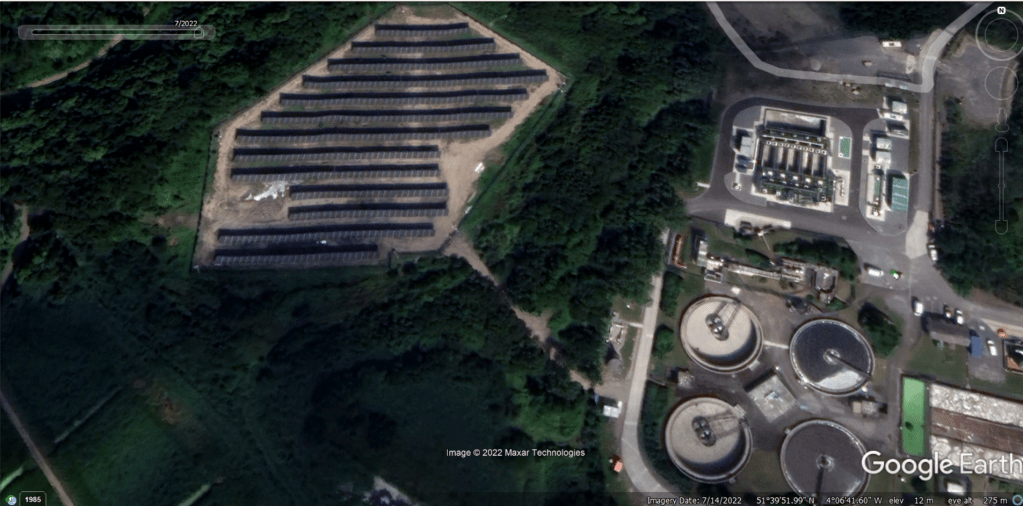
Preliminary Ecological Appraisal. Our Preliminary Ecological Appraisal of the Llanelli Welsh Water site was undertaken in support of plans for a renewable-energy, solar-panel array to provide power to the water processing equipment on the main site. Situated just to the north of the Loughor estuary, the potential development area was a small piece of unmanaged waste land which had clearly been subjected to waste storage, fly-tipping, burning and unauthorised grazing by ponies, although there were clear signs of vegetative succession. The area was largely enclosed by a man-made bank with scrub and small trees growing on it; the banks were not going to be modified by the installation work. The dominant vegetation type on site was marshy grassland overlying a gravel-heavy substrate, although the site was frequently waterlogged, with a pond and two ditches with occasional standing water along with several small areas of seasonal/transitional standing water.
Despite the site’s moderately unused and neglected state, and patches of willow regrowth, it had low biodiversity and conservation value because of the limited floral assemblage and significant contamination by anthropogenic wastes. The assessment of the work required to install the panel arrays, mounted on support structures which were fixed in place using micro-piling techniques, determined that it would have no impact on the nearby protected areas/habitats.
Water Vole Survey. The water vole survey confirmed that the ground around the pools had a high gravel content and was thus suboptimal for burrows, whilst the adjacent seasonally-wet ditches had a mixture of stone and mud banks. Despite two thorough searches of the areas around the standing water, including from within the water bodies themselves, no water voles or associated field signs were seen, and although some of the reeds had been cropped, this damage had been inflicted by grazing horses that were occasionally released within the site.
Otter Survey. Similar surveys for otter presence found no field signs of these animals and also concluded that the water bodies were of no real value to them. Furthermore, we concluded that, although neighbouring sites contained habitats that would better support otter presence, there was an extremely low probability that otters would use the potential development site to commute between them.
Over-wintering Bird Survey. The over-wintering bird surveys took place over 2 consecutive winters, between November and February, and demonstrated that, aside from our occasionally disturbing 2-3 foraging Snipe, no other migrants showed any interest in the proposed development site, even during periods of very high tide within the local estuary. Indeed, relatively low levels of activity were witnessed by even the more common passerine species that the habitats present might be expected to attract. During one of the post-dusk survey sessions, calls were detected from Tawny owls, and one was witnessed briefly, flying along one of the site borders.
Impact of Reflections on Local Bird Roosts. Our detailed calculations undertaken based on the position and orientation of the solar panels, supplemented by detailed reviews of the local terrain using mapping software and in-field surveys, confirmed that any reflections of the sun caused by the panels would not be visible from the estuary and associated feeding/roosting areas for over-wintering birds.
The combination of the reports issued following each of these surveys provided mitigation advice and recommendations to prevent harm coming to any creatures which might find its way onto the site during construction and the long-term operation. Installation of security fencing and the solar array has now been completed.
If you would like to find out how we could provide ecological support to your development project, please contact us.
For similar information on other projects, please take a look at the Our Work page.
 JP Ecological Services
One thought on “Renewable Energy for Llanelli Site”