
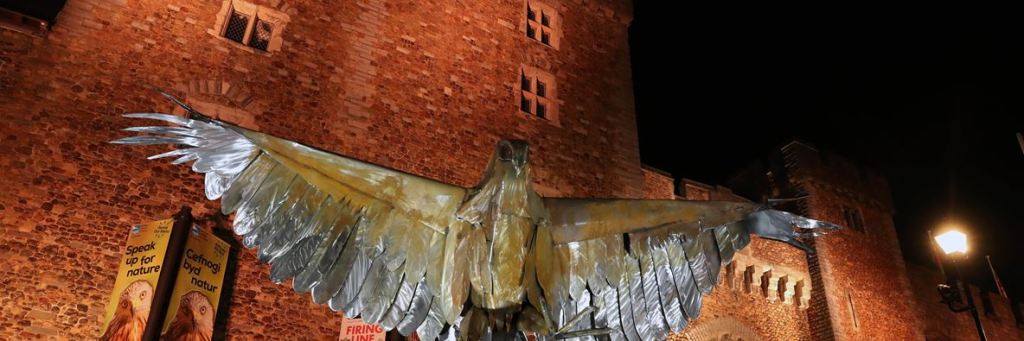
A huge Red kite recently made an appearance outside Cardiff Castle to mark the launch of RSPB Cymru’s “Revive our World” campaign. The 3.5m high sculpture also celebrates the hugely successful recovery of this species in Wales over the last 100 years. We have greatly appreciated this particular success during many of our wanders through the Brecon Beacons, where we invariably come across one or two of these majestic birds soaring over the valley slopes searching for prey. Occasionally we have also sighted them during our surveys, although principally along the southern edges of the Beacons with very irregular appearances between there and the coast. It seems to us, at least, that even though the birds each have relatively large territories, most of them remain pretty close to the central belt of feeding stations, set up by enterprising farmers, where dozens of birds gather daily to take advantage of the free food – they certainly know “which side their bread is buttered on”.
The success of the Welsh programme led to a similar reintroduction in the Chilterns in England, where, if anything, the ranges now occupied by the Red Kite have become much larger. These population increases definitely demonstrate that positive intervention by man can make a huge difference to the natural world around us.
Of course, the Red Kite isn’t the only species whose numbers have been decimated through man’s activities in farming, industry and urban development or even through direct persecution, and the RSPB’s new campaign offers a number of ways in which members of the public can support the recovery of nature as a whole. We wish them every success in helping our communities to demonstrate to our politicians, industrialists, developers and farmers just how much a healthy natural world really means to us.
Although we haven’t yet been involved in any ecological programmes as large as the reintroduction of a national icon, we have been delighted to have assisted our clients to make adjustments to their development programmes to protect and incorporate valuable living space for a wide range of creatures and habitats. The creation or protection of dozens of “oases” across our countryside can, when accompanied by similar work on our farms, roadside verges, wild spaces and gardens, offer refuges to a huge number of different plants, insects, birds and animals, as well as making our working and living environments more pleasant to be in. If you would like help in making space for nature in your development project and contributing your bit to “reviving our world”, then please contact us.
 JP Ecological Services