
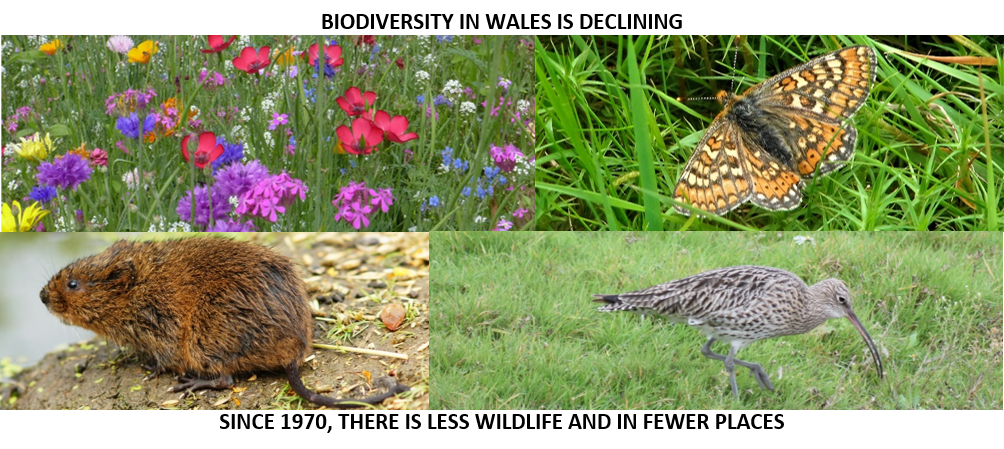
On 30th June 2021, the Welsh Senedd voted (by 40 members to 13) to declare a “Nature Emergency” in Wales as well as calling for legally enforceable biodiversity targets to be put in place. This recent declaration follows on from the publishing of a Nature Recovery Action Plan for Wales in late 2015 and the declaration of a “Climate and Ecological Emergency” in spring 2019. Changes in our environmental and ecological legislation and processes are thus clearly in the air.
All of these initiatives are in recognition of the fact that environmental pressures are causing global biodiversity declines at rates not previously encountered in human history and that the rate of species extinctions continues to accelerate. In Wales alone, it seems, that 73 species have become extinct since 1970, and a further 666 species are currently under threat. Furthermore, it is now more widely acknowledged that nature plays an essential role in providing food, energy, medicines and genetic resources for us to use and that if changes aren’t made now, losses of biodiversity and the negative impact on nature’s benefits to people will continue.
Although there is much work to be done to finalise any new legislation or detailed corrective action plans, the last State of Nature report has already identified agricultural management, climate change, hydrological change, urbanisation, invasive non-native species, pests and pathogens, pollution and woodland management as being the key drivers in the loss of biodiversity throughout the UK. Furthermore, Wales’s Strategy for Nature sets out an ambition ‘to reverse the decline in biodiversity, for its intrinsic value, and to ensure lasting benefits to society’, with objectives which include: embedding biodiversity throughout decision making at all levels; safeguarding and improving the management of species and habitats of principal importance; increasing the resilience of our natural environment by restoring degraded habitats and through habitat creation; tackling key pressures on species and habitats; improving our evidence, understanding and monitoring; and installing a framework of governance and support for delivery.
It is reasonable to expect that, in addition to new schemes to encourage plans for nature-based solutions and projects which centre on species recovery, there will be increased emphasis on ensuring that development projects protect and promote biodiversity throughout the planning, construction and operational phases of their lives. It is likely therefore that local planning authorities will require high-quality evidence that nature has been given due consideration and protection during all aspects of a development project and that damage to key habitats and species is avoided. In addition, the authorities are more likely to require that measures be included in plans and processes to improve the range of plants and creatures that benefit from the changes – it will pay dividends therefore for project managers to keep their ecologists involved in all aspects of the venture to ensure a win-win outcome for both nature and the developer. If you need ecological support for your project, then please contact us.
 JP Ecological Services
2 thoughts on “Wales Declares Nature Emergency”