
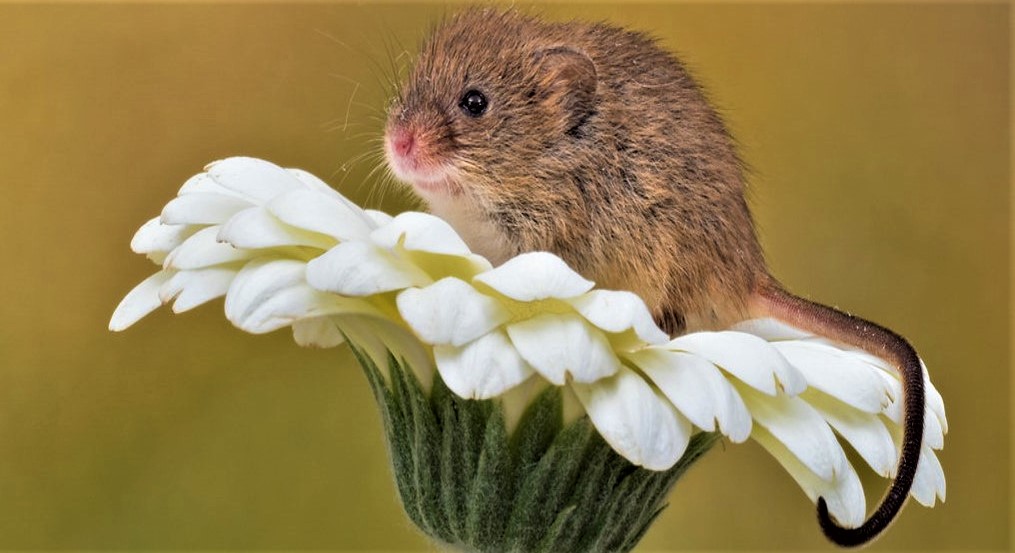
We were heartened to read recently of more attempts to improve the populations of our small mammals, and in particular the success of a number of programmes in England relating to harvest mice, undoubtedly UK’s smallest mouse weighing in at only 4 to 6gms. In the past, these diminutive creatures were seen in large numbers when cereal crops were harvested by hand, but today they are more likely to make their homes in areas of tall grass on roadside verges, hedgerows, field margins and ditches, where they are safer from the ravages of combine harvesters. Rarely seen nowadays, because of their small size, sensitivity to disturbance, their dawn and dusk feeding forays and low numbers, the presence of harvest mice is generally confirmed through finding their nests woven into the tall grass stems, about a metre above the ground.
Although still thought to be reasonably widespread in England, despite falling numbers due to habitat loss, harvest mice are classified as “vulnerable” in Wales, where populations are thought to exist in relatively few locations, and this probably explains why, disappointingly, we have yet to discover harvest mouse field signs, despite having surveyed many sites with potentially suitable habitat. The situation is even bleaker in Scotland, where only a few have been recorded in the southern areas of the country and their status is assessed as “critical”. Their low, and probably decreasing, numbers mean that they have been included as a Priority Species in Local Biodiversity Action Plans throughout the UK for some years, although there isn’t yet a huge amount of information on how these plans have progressed.
Nevertheless, at Northumberland Wildlife Trust’s East Chevington nature reserve, 100 captive-bred harvest mice were released into the reed beds there in June of this year to add to a population of creatures that are probably descendants of 240 released there in 2004. At that time, conservationists thought that the first release hadn’t been successful, because follow-up surveys failed to locate any of the mice or nests; however, 15 years later, volunteers discovered 4 distinctive harvest-mouse nests, suggesting that the habitat was indeed suited to these creatures. All being well, another 200 harvest mice will be released there in August.
Meanwhile, at the other end of the country, the National Trust has been restoring part of the Holnicote Estate, west of Minehead in Somerset, to improve habitats for water voles and harvest mice. 2019 saw the first release of 198 harvest mice into an ungrazed meadow comprising rough grassland and dense hedgerows, and this was due to be followed up by a second release last year; however, the C-19 pandemic put paid to that, so it is hoped that this population top up will now take place this year. And in yet another corner of the UK, teams of citizen scientists have discovered just over 1000 harvest mouse nests over the past 5 years, spread across about one third of the county of Kent. Although this sounds encouraging, comparisons with limited historical records suggest that the area of harvest-mouse habitat might have shrunk by about 20%.
As we have previously noted, there appears to be an increasing will to redress the damage that we have caused to our environment and its other occupants, and there is more emphasis being put onto increasing biodiversity and protecting habitats, so let’s hope that the harvest mouse, amongst many other species, soon benefits from more re-introduction schemes and improved land management as new legislation unfurls. We are certainly looking forward to meeting one of these cute creatures in the future.
 JP Ecological Services