
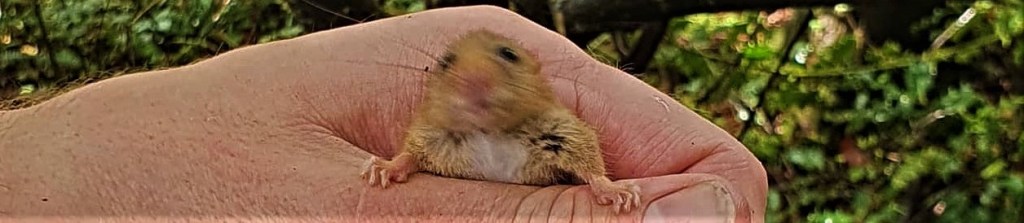
Well, here we are in mid-September, a month that is a particularly busy one for Hazel Dormice as they start to prepare for their long winter sleep. If you are ever going to detect the presence of dormice in the wild, this is the month that you are most likely to, although even now, their secretive and nocturnal habits mean that you are most likely to find abandoned nests and chewed nut shells than actually seeing a dormouse itself. So, what better time for the People’s Trust for Endangered Species to celebrate Dormouse Week – an opportunity to try to raise funds and engage more people in caring for this rare creature?
Coincidentally, we have recently been involved in a dormouse survey, not far from Exeter, where as a part of a team with fully licensed ecologists, we came across several juvenile dormice who, we were pleased to note, were almost up to the appropriate body weight to see them through the winter months, even though they still have another few weeks in which to build up fat reserves for their long sleep. We were amazed to learn more about the variety of summer nests that dormice use and to have the opportunity to handle these delightful creatures; something which is against the law unless under the supervision of fully-licenced handlers. We thoroughly enjoyed the training element of the survey and are looking forward to more opportunities to work with these animals in order to get the whole team trained up for a full handler’s licence.
Sadly, dormice are nowhere near as common these days as they were, principally through the loss of their natural habitat of large, well-established woods and hedgerows, where a high degree of diversity among tree and shrub species provides an unbroken sequence of foods (buds, flowers, young leaves, and insects) throughout the summer. Although the dormouse is closely associated with hazel, its principal source of nuts for its autumnal feasting, bramble, oak and honeysuckle are also important sources of food. Sycamore, sweet chestnut, birch, yew, hawthorn and broom also provide useful sources of insects and pollen.
Unfortunately, dormice are highly territorial and also very reluctant to travel long distances, especially if they have to come down out of vegetation cover and cross open ground, so, once a population disappears from a woodland or hedgerow, it is often very difficult for it to re-establish itself. However, some help is at hand, and we reported on the release of the 1000th hand-reared dormouse into the wild earlier this year. We hope that they all make it through to next spring and look forward to further releases in suitable woodlands in future years.
Good luck to the People’s Trust for Endangered Species for this week and for its future activities – hope you can help.
 JP Ecological Services