
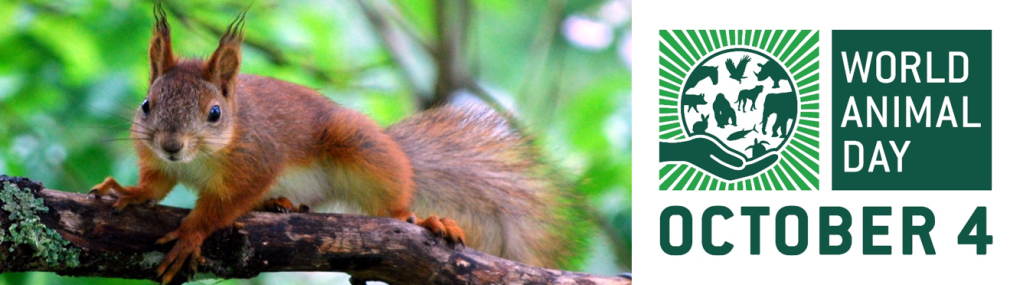
As September starts to fade away, World Animal Day pops up on the horizon. Seemingly confused on some websites with World Wildlife Day, which is commemorated in March, the mission of World Animal Day is “to raise the status of animals in order to improve welfare standards around the globe. The ultimate goal is to ensure that animals are recognized as sentient beings and that we do all we can to improve their welfare.
Originally envisioned by Heinrich Zimmerman in the early 1920’s, early followers were principally in Germany and its neighbouring countries, but, at a congress of the world’s animal protection organizations in Florence in May 1931, his proposal to make World Animal Day universal on 4 October was unanimously accepted. World Animal Day thus became aligned with the feast day of Francis of Assisi, the patron saint of animals, and incidentally of us ecologists.
Since its conception, World Animal Day associated work has increased awareness and education and led to legal reform and social progress to make this world a fairer place for all living creatures. Encouragingly, several nations are now considering legislation to recognise animals as sentient beings, with a view to ensuring that full regard is always paid to their welfare.
Of course, improving animal welfare standards also has an impact on our way of life. Ecosystems are extremely fragile, and if one species is severely depleted or becomes extinct this often has serious repercussions for the rest of the local system. Increased awareness of the importance of conserving the balance in our ecosystems will thus ensure tens of thousands of people will also maintain their livelihoods.
So, how do you becomes involved in World Animal Day activities? The official website includes access to resources which might be useful to individuals or a wide range of organisations, including schools, workplaces and clubs, whilst other suggestions are proposed on other sites. We also discovered that googling “World Animal Day activities” along with your local area produced some suggestions for activities and events. Why not give that a try too?
We always strive to develop our knowledge of Britain’s native flora and fauna, as well as best current practices, to ensure that the advice we offer clients both suits their projects as well as promoting the well-being of our natural world. Let’s hope that World Animal Day activities encourage more of our population to improve the welfare of the animals in their lives.
 JP Ecological Services