
South Tyneside Council has taken the revolutionary approach of developing an energy centre on council-owned brownfield land to provide heat across the Jarrow region. The £10 million scheme will remove water from the River Tyne, extracting heat from the water and distributing it to 11 properties including high-rise flats, council offices, care homes and supported housing. A solar array will power the heat pump, and on-site battery storage will permit efficient use of the renewable electricity produced on site.
We were commissioned by COGEO to undertake a number of ecological studies, including a Habitat Survey on the main site, a survey of the trees within an adjacent Priority Woodland area and a Biodiversity Net Gain Assessment. Although we identified the need for some more detailed ecological studies, the Covid 19 pandemic and associated English and Welsh lockdown and travel restrictions meant that these surveys had to be undertaken by a more local team of ecologists to enable the project to proceed promptly.
Phase 1 Habitat Survey
The site had previously housed 2 factories, producing paint and lead products, and their associated carparks, roads etc. Although the buildings had long been removed, large concrete foundation areas remained; these had been degraded to varying degrees through colonisation by both rank vegetation (e.g. bramble, rosebay willowherb, nettle etc.) and invasive non-native species (e.g. Japanese knotweed and buddleia) to form a scattered scrub. Overall, the site was classified as Open Mosaic Habitat on Previously Developed Land.
The foundation areas were separated from each other and the neighbouring areas by narrow strips of semi-mature woodland, dominated by birch and willow about 10m tall, along with abundant quantities of buddleia. The understorey within the strips varied from sparse, in areas where the canopy had closed, to areas of dense bramble scrub in areas with a more open canopy. Another area of woodland in the NW section was more mature than the barrier strips, with a much greater diversity of species, ages and structures (including small open clearings and scrubby areas).
Grassland in the north-east of the site was split into 2 distinct types. A heavily-rabbit-grazed area of fescue and moss dominated grassland (sward height <1cm), with noticeably few forbs, yielded abruptly to a taller-rank-grass dominated grassland (cock’s foot and false oat grass) and then to bramble dominated scrub. The flowering species within the taller grassland area were dominated by dock and thistle, with very few examples of finer flowering species.
An isolated pier-type structure, a remnant of the historic Hebburn Staithes, at the river edge was checked for nesting birds using high-powered lenses. The adjacent river banks are relatively steep and showed high levels of modification, whilst the length of riverbank to the east of the staithe has had rock armour installed along its length. Similar rocky habitat continues between the river bank and the staithe. However, on this more-sheltered area, large quantities of Bladder and Serrated wrack were able to grow, covering over 80% of the lower section of the beach and the supports of the staithe. During the period of both days of surveys, no other sediment deposits were exposed by differing water levels, including the area to the west of the site indicated as a priority mudflat habitat by the DEFRA mapping application.
A Local Ecological Records report was analysed to reveal the protected species identified within various distances of the site and we assessed the likelihood that included flora and fauna would be affected by the development work as well as providing generic precautions to protect creatures that might commute through it. The report also identified the need for further surveys in respect of invertebrates, otters, badgers, bats and reptiles as well as the preparation of plans to protect river species and habitats from damage incurred by the water extraction process and contamination both during the development and operational phases of the energy centre.
Evaluation of the Effects of the Development on the Priority Woodland
The proposed development site has a strip of deciduous woodland, about 50 metres wide, which has been designated as Priority Woodland, on its northern boundary, but our inspection revealed no veteran trees were included. The trees within 10 metres of the southern boundary fence were largely semi-mature specimens of Sycamore and Birch, with some Beech, Hazel, Blackthorn and Holly included. The northern edge of the woodland strip, adjacent to the riverside path, also contains Dogwood, Elder, Crack Willow, Hawthorn and horticultural variants of Cotoneaster, Laurel and Holly.
Although the northern edge of the proposed solar panel installation was about 30 metres south of the wood’s boundary fence, the proposed Energy Centre, Battery Storage and Gas Meter House buildings would be situated between the solar panels and the wood’s southern boundary fence. It was possible therefore that the work relating to this development might affect the roots of the trees within the priority woodland area.
Our measurements of 154 trees enabled us to determine that a 5m boundary strip within the development site would protect the roots of the trees within the priority woodland from damage incurred by the development.
Biodiversity Net Gain Assessment
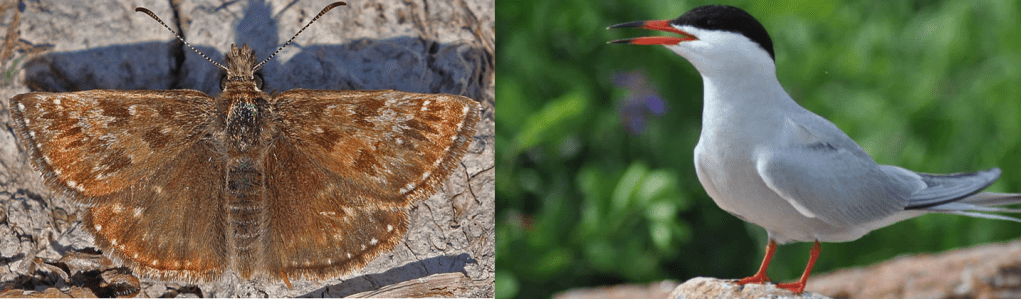
Although the site was classified overall as Open Mosaic Habitat on Previously Developed Land, it was broken down into areas of woodland, scrub, grassland, rocky shore, urban and sparse vegetation for the purposes of the Biodiversity Net Gain assessment. Employment of the criteria specified in Natural England’s Biodiversity Metric 2.0 enabled us to identify the pre-development biodiversity value of each of the habitats and thus to compare our proposed post-development design to ensure that an overall improvement was achieved. Our design specifically included focus on 2 notable species, the Dingy Skipper butterfly and the Common Tern, both of which had been detected using the current site, as well as aiming to avoid loss of any habitat type and achieved a net gain of more than 15%, satisfying local ecological requirements.
It was concluded that the site’s previous usage was likely to have led to contamination of the soils with chemicals that are less than favourable for healthy plant growth. It is therefore thought likely that the development of a healthy, biodiverse, fully functional habitat would take considerably longer here than in an area less likely to be contaminated with similar chemicals and run-offs. It is likely that this assessment will need to be refined once the development design is finalised, but it is anticipated that the biodiversity of the site will be significantly improved through the adoption of the proposed enhancement measures, alongside the development work.
 JP Ecological Services
2 thoughts on “Renewable Energy Centre for Jarrow”