
The BBC’s recent series entitled “Earthshot Prize – Repairing our Planet” provided powerful testimonies on how badly our world has been affected by climate change and biodiversity loss but also outlined several seemingly promising projects which could help redress the balance. Fifteen of these projects were in competition, across the 5 different categories each of which had a £1 million prize, in order to scale their projects up over the next decade to make a real impact on our world. This competition is due to be run annually for a number of years.
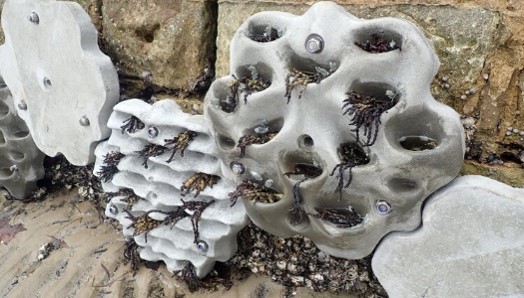
One of the projects that caught our eye revolved around re-instating and improving the biodiversity lost by development of our coastal areas, specifically through the building of structures like seawalls, pilings, harbours, ports, marinas, pontoons and coastal defences. Generally principally made with relatively smooth concrete surfaces, these structures don’t allow the development of comprehensive marine eco-systems to replace those in place before building commenced. The solution involves installing a matrix of habitat units with indentations, ripples, nooks and crannies that a variety of sea plants and creatures can “call their homes”. As with so many eco-systems, once a key element has been restored, the creatures and plants which rely on it will also return and thrive, and the previous natural richness will be regenerated.
The inventors, Living Seawalls, of these retrofittable devices have estimated that the area of sea floor already affected by marine infrastructure across the world exceeds that of the planet’s mangrove and seagrass forests, so the potential for biodiversity recovery is huge indeed. Living Seawalls has already demonstrated the potential of their solution through 10 installations in Australia and others in Gibraltar, Singapore and Milford Haven in Wales. Let’s hope that the authorities which manage current marine infrastructures across the world can be persuaded to help reverse the loss of biodiversity in their areas of responsibility and that ecologists, planners, architects, developers and builders will include such measures in future projects.
Although this year’s prize was won by another worthy project, we hope that Living Seawalls will receive funding from another benefactor, and we wish them every success in their work to restore marine environments. Click here to learn more about the Earthshot Prize.
 JP Ecological Services
One thought on “Habitat Units Restore Marine Ecosystems”