
Over the past 3 years, we have undertaken many ecological surveys of different types in support of the installation of solar-power and wind-turbine renewable energy sources at water treatment works across Wales. Thankfully, we have usually been able to avoid much of the dreadful smell that is associated with such places, although on many occasions we have worked on areas of waste land that had historically been used for the disposal of sewage sludge, and we have had to consider the habitats present around the various water treatment and storage areas. Between us, therefore, we felt that we probably knew more than one really needs to know about water treatment processes and its infrastructure. However, the BBC Horizon programme entitled the “The Secret Science of Sewage” proved us wrong, and we were staggered at the huge potential value of incorporating wide-scale modifications to the way that our sewage is treated.
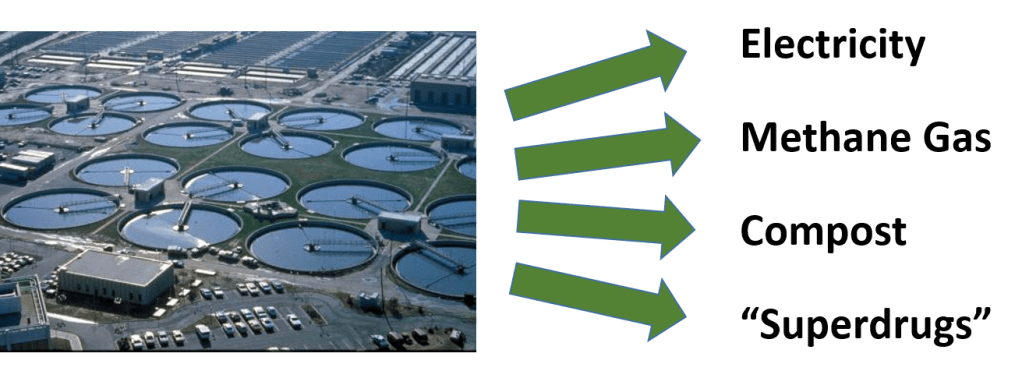
Amongst the potential benefits outlined were 2 forms of renewable energy. The first involved a relatively new concept, that of microbial fuel cells, and it was amazing to see how close scientists and engineers are to developing systems for use in our homes and work places. The fuel cells comprise permeable ceramic structures which house bacteria that react with the contents of urine to generate electricity. It is envisaged that, when coupled with suitable urinals, these fuel cells will be able to provide at least part of the electrical requirements of future homes, before the waste is then passed into the sewage system. We would imagine though that the need to modify thousands of individual homes will slow the achievement of significant results from such a system, although it could be built into new houses and workplaces reasonably easily.
The second form of renewable energy arises from developments that enable modern sewage works to pass the sludge which has been separated from the water content into bio-digesters, which are maintained at about 40oC to generate methane gas. This natural gas can then be fed through pipelines to supply homes and workplaces with fuel for heating and cooking or further processed to enable it to be used in place of petrol in vehicles. One modern sewage plant near Birmingham apparently already supplies methane gas to thousands of local homes every day. Once dried, the sludge can be turned into compost and thus safely used to condition soils for agriculture and gardens, providing yet another benefit.
Another huge potential benefit stems from the discovery of thousands of different types of “phages” within the raw sewage mixture; these micro-organisms generally only measure thousandths of a millimetre in length, but each type specifically targets and feeds on one type of bacteria. The potential for the development of new drugs or treatments for illnesses is therefore colossal. At present, scientists are concentrating on finding phages to tackle the “superbugs” which are resistant to our current drugs, and some treatments have already been trialled on patients in palliative care with incredible results. Of course, there is still much to do to make such treatments available for wider use through our hospitals, but the promise for the future is huge.
Clearly, the benefits of improved sewage treatment are not to be sniffed at, so it would be great to see the widespread adoption of these changes in the near future.
 JP Ecological Services