
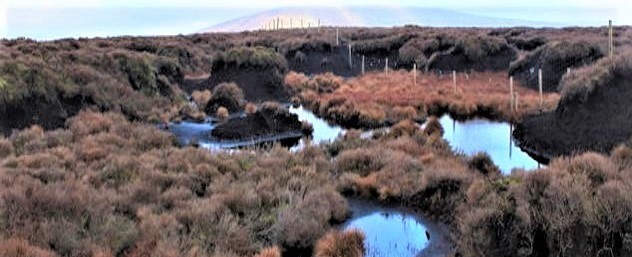
It was great to read of significant successes in an RSPB project designed to restore peatland and blanket bog habitats in the Migneint Special Area of Conservation in north Wales. This project commenced in 2017 in conjunction with The National Trust, Natural Resources Wales and a local farmer. Much of the work involved blocking drainage ditches and deep erosion gullies in the area which had historically been blanket bog before being dried out for sheep grazing and grouse shooting. In addition, the creation of thousands of small dams led to the reforming of pools and to the regrowth of specialist bog plants.
Pleasingly, the recovery has also extended to re-establishing colonies of insects, butterflies and moths as well as providing new homes for hen harriers, curlews, plovers and grouse. Golden plovers are certainly benefitting from feeding on the increased populations of crane-fly larvae, who favour wet peatlands, and 2 pairs have nested in the SAC this year. Four pairs of curlews have also made nests in the reclaimed area, and chicks of both species were seen this summer, the first since the 1990s.
As if these biodiversity improvement successes weren’t enough, the new bogs will also prevent the carbon sequestered in the past from being released, as the established peat dried out, and extract more carbon from our atmosphere as further peat develops. Since it is estimated that UK peatlands store more carbon than all the forests in UK, France and Germany combined, these contributions are not to be sniffed at. In addition, by retaining rainfall and releasing the water slowly, the new bogs will reduce the risk of flooding to housing, workplaces and farmland lower down the valleys, whilst the bog vegetation filters the water as it passes through. All of these benefits look as if they will be very important towards reducing the impact of global warming on human lives.
In a further restoration project, it looks as if new funding will permit work to start in the peat-capped hills surrounding Lake Vyrnwy. In this case, the initial aim is to restore 600 hectares of peatland over the next 5 years, but it is hoped that the restoration can be extended to 1000 hectares as the project progresses. If the results of this project reflect those achieved at Migneint, we will have made real progress.
 JP Ecological Services
One thought on “Peatland Restoration Successes”