
We were commissioned by ecologists of Spectrum Ecology to assist them in studies related to housing development proposals affecting the site of the former Bedwellty Comprehensive School estate, adjacent to the Aberbargoed Grasslands Special Area of Conservation (SAC). The grasslands area also included a Site of Special Scientific Interest (SSSI) and a National Nature Reserve.
Building had already commenced on the area once occupied by the school buildings, and a new proposal was being prepared to extend the development onto the school sports fields. Spectrum Ecology had already completed the Preliminary Ecological Assessment (PEA) for the new site, but local authority and Natural Resources Wales (NRW) ecologists had requested an Environmental Impact Assessment (EIA) for the total development. Subsequently, we were tasked with conducting a habitat assessment of the whole SAC and detailed National Vegetation Classification (NVC) surveys of the area within the 200 metre zone of influence for the proposed development to help form the Ecological Impact Assessment.
The developer added high-efficiency boilers and electric vehicle charging points to his plan, planning permission for the development was subsequently granted and some houses are now already occupied. In addition, the results of our surveys were passed onto the SAC managers for consideration during revisions of the management plan for the reserve.
Visit the “Our Work” page to see other case studies and examples of our work. If you think we could help you with your ecological requirements, please contact us.
Habitat Assessment
The habitat assessment was undertaken over 3 visits in late May, and the area was assessed to comprise a wide variety of habitats including: “Marshy Grassland”; “Unimproved Grassland”; “Species rich, Semi-improved Grassland”; “Semi-natural Broadleaf Woodland”; “Hedgerow”; “Tall Ruderal Vegetation”; “Scrub”; “Bracken”; “Scattered Trees”; “Lines of Trees”; “Arable Grassland” and “Amenity Grassland”.
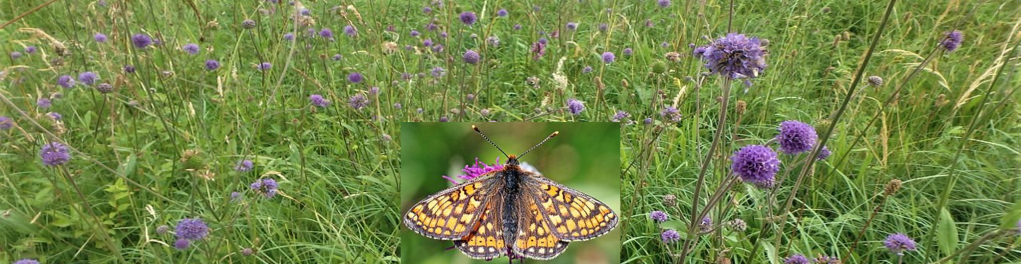
Although some of the grassland areas had clearly been managed in the past, several were now being encroached by scrub and woodland species and would benefit from increased management. In addition, bracken was increasingly encroaching on marshy grassland areas, suggesting that these areas were drying out. Molinia and Devil’s bit Scabious growth varied from sparse to well-developed, with the latter supporting small populations of Marsh Fritillary; Small Pearl-bordered butterflies were also seen. The woodlands included a mix of veteran, mature and semi-mature Oaks, Ash, Willows, Beech and Silver Birch.
NVC Surveys
These surveys require detailed inspection of sample areas to identify both the type and % cover of the plants within them. The results allow classification of the area into nationally recognised habitat types. In this case, we were trying to determine whether the areas of grassland within 200 metres of the development area were classified as Molinion meadows and thus needed to be protected and whether they provided suitable habitat for Marsh Fritillary butterflies.
Analysis of 15 randomly positioned quadrats, inspected in early June, revealed that none conformed to the classifications classed as Molinion meadows and that only 3 could be classified as “suitable” for Marsh Fritillary butterflies. Furthermore, even these 3 areas were isolated from the grasslands that clearly had butterfly populations by patches of dense woodland, which would effectively prevent established colonies from accessing them. Nevertheless, if resources could be made available, the SAC management plan could be amended to incorporate development of these areas into good habitats for this scarce butterfly.
Impact Assessment
The Aberbargoed SAC was principally designated because of the presence of a significant population of Marsh Fritillary butterflies and their caterpillars’ food plant Devil’s Bit Scabious, and interrogation of the NBN database confirmed recent sightings of both within a 2km radius of the development site. Although some of the sightings of Devil’s Bit Scabious were in areas “just over the fence” from the development site, those of the butterfly were restricted to the northern, more distant, sections of the SAC. A secondary element of the SAC designation was the presence of Molinia grasses, and the PEA had classified the woodlands bordering the development site as Wet Woodlands, another priority habitat.
Recommendations were made to ensure:
- A detailed Construction Environment Management Plan was prepared to include the SuDS scheme, the management of ground-water, airborne, noise and vibration pollution and biosecurity measures related to invasive non-native species (INNS).
- The Wet Woodland areas would not be developed.
- No development or habitat modification was undertaken within 10m of the boundary with the Aberbargoed SAC.
- A robust fence was installed between the development and the SAC to prevent direct human access to the SAC, whilst permitting the passage of small mammals, with signage installed to direct people to appropriate entry points.
- Street lighting was positioned to avoid affecting the surrounding woodland.
- Specified precautions were taken during construction phase to protect animals and birds from injury or loss of living quarters.
Other Sightings
Although outside the proposed development area, we came across a patch of relatively rare bee orchids growing in roadside grassy patches. The location was passed to botanists who were conducting a nationwide survey of these plants.
 JP Ecological Services