
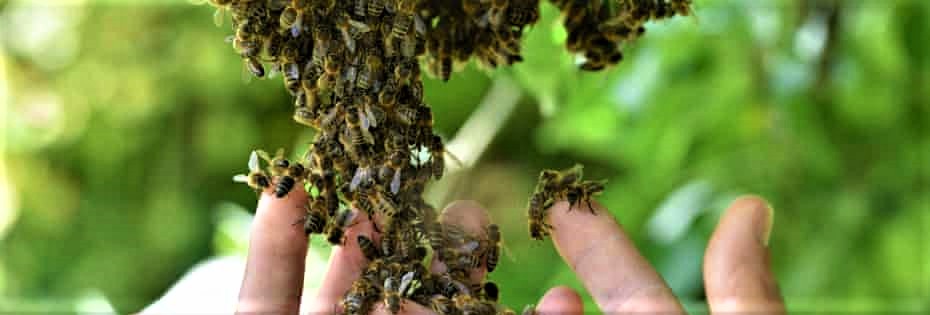
Incredible news was recently announced on the discovery of a significant population of English, forest honey bees which were long thought to have been wiped out through competition with imported varieties of honey bee and disease. Living in ancient woodlands in southern Britain, this discovery is a reminder of the wonders still hidden in these habitats and that we should preserve them and integrate them into development plans, rather than tearing them down.
Filipe Salbany, who discovered 50 colonies of this “new” bee, has observed that it occupies small tree cavities, as wild bees have for millions of years, and that remarkably they seem to have the ability to thrive despite the ravages wreaked by the varroa mite on commercial honey-bee populations. The bees in these newly-discovered colonies also have other differences to both hive-dwelling varieties and the non-native honey bees which have gone feral after abandoning hives to live in the wild. Unusually, the swarms of these “new” bees have several queen bees, rather than the more usual one, thus increasing each colony’s survival prospects, and they have been seen seeking out honey dew in tree tops at much lower temperatures than traditional bees. These bees appear to be well integrated into the woodland habitat, unusually sharing trees with wasp nests, and have most likely remained undetected because their nests have very small entrances and are usually located very high up in the trees.
Although the results of DNA tests are required to confirm that these bees are true descendants of the indigenous honey bees, which used to forage in the English countryside, they are smaller, darker and furrier, with more prominent wing veins, than other variants, suggesting they are a new sub-species of this lost pollinator. It would be wonderful if further studies of these bees were able to guide improvements within the commercial honey-bee stock to help combat the effects of the varroa mite.
 JP Ecological Services
One thought on “Ancient Honeybees Discovered”