
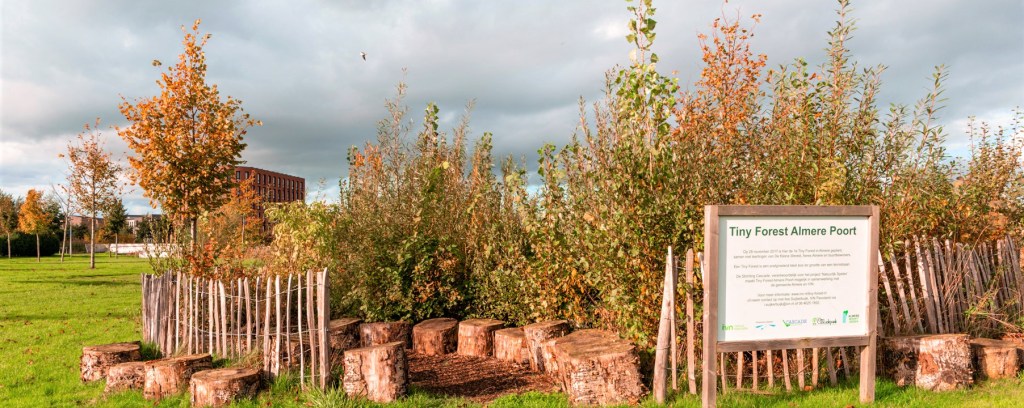
The advent of so-called “Mini Forests” in Europe has received a fair amount of publicity over the last few years, and their increasing adoption has led to concerns on the part of some environmentalists and ecologists. Nevertheless, these “forests” have found particular favour in Japan and neighbouring countries and, more recently, The Netherlands; some have also been planted in more than 50 cities across the world as well as in Belgium, France and the UK. Given their characteristics, we believe that these so-called “mini forests” might make a valuable contribution to improving the biodiversity of nature within developments on housing and industrial estates, but shouldn’t be regarded as satisfactory alternatives to, or mitigation for, the unnecessary destruction of existing forests and woodland.
The technique, developed in Japan by Akira Miyawaki and “exported” to Europe by Indian entrepreneur Shubhendu Sharma, relies on undertaking soil surveys to decide whether nutrients, water retainers, micro-organisms and perforator materials (to break up more compact soils and foster good root growth) are required. As important, though, is the selection of a wide range of native tree species (30 or more) which are best suited to the area and the determination of the best combination of trees and shrubs to form the upper canopy and 3 lower levels of vegetation. Seeds or saplings are then planted at high densities (3 saplings per square metre) and protected by the application of locally sourced mulch. In most cases, the new wooded areas seem to require maintenance for only the first couple of years and can thereafter be left to progress naturally.
Despite the technique trying to mimic the structure of a natural wooded area, many observe that the small size of most mini forests, often only tennis-court sized or less, does not merit the word “forest” being included in their description and actually serves to undervalue the real forests across the globe. In addition, because the trees are all planted at the same time, the resultant woodland doesn’t have the mix of new, mature and dead wood within it, although studies have shown that it does quickly form a semi-mature eco-system with high levels of biodiversity. Another significant concern is that there is evidence that they are being used as mitigation for the destruction of huge wooded areas which are hundreds, or possibly, thousands of years old. Such ancient forests, with their huge diversity of structure and species, cannot possibly be replaced by new woodland areas, even if they have been planted using Miyawaki techniques.
Having said that, it appears that ecologists world-wide feel that there is some merit in planting small wooded areas using these techniques, in that they grow ten times faster than “standard” planting techniques, becoming a stable multi-layered community in 20-30 years instead of hundreds of years. In addition, the density of planting means that Miyawaki trees absorb more carbon than in more conventional woodland cultivation processes and they have been found to have much greater biodiversity than neighbouring patches of trees. However, given that all these “forests” had biodiversity designed into them from the start, this is perhaps unsurprising. Furthermore, since all these “forests” are less than 50 years old, it remains to see how biodiversity will be affected once the upper canopy trees are fully developed. Nevertheless, their siting in urban areas, where “empty” space is at a premium, could provide biodiversity oases linking larger local wooded areas, aesthetically pleasing nature areas and opportunities for local populations, especially school children, to learn about and experience wooded areas. In some roadside locations they have reduced the volume of noise affecting local accommodation. So, as with all things, provided “mini-forests”, or perhaps more appropriately “Miyawaki woodlands”, are employed for the right reasons, they do appear to have a place in the fight to reduce atmospheric carbon content and to improve our nation’s woefully poor biodiversity ratings.
 JP Ecological Services