
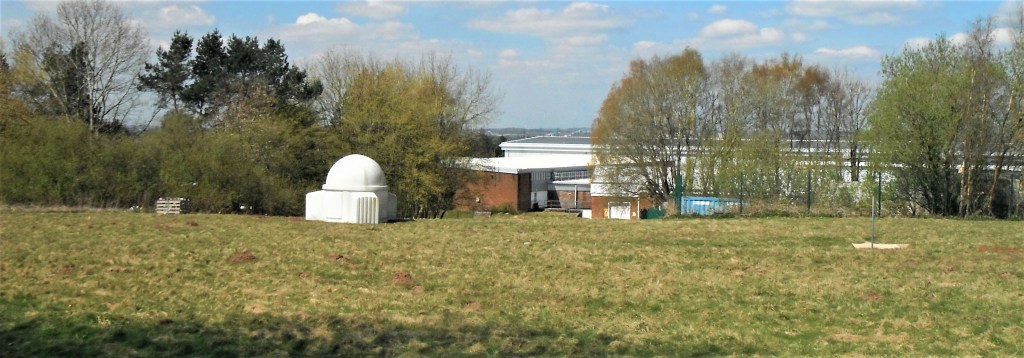
The project to install solar panels within the Sci-Tech site at Daresbury has recently been granted planning permission, and the installation phase is expected to commence shortly. We were commissioned, by Cogeo Planning and Environmental Services, to undertake a Preliminary Ecological Assessment (PEA) of the proposed development site (PDS) earlier this year. We subsequently completed a 4-week study to confirm that badgers from local-area setts were not making use of the PDS or numerous large holes discovered within 30 metres of the proposed work area.
We also made recommendations to improve the biodiversity of the development site on completion of the works.
For information on other projects we have assisted in, please browse the “Our Work” page. If you would like ecological assistance with your development project, please contact us.
Preliminary Ecological Assessment. The PEA revealed that the site was dominated by grassland overlaying a highly acidic, mineral rich substrate, with numerous indicators of a damp habitat, i.e. willow, alder and rushes and soil probe readings indicating the topsoil to be moderately wet even after a period of prolonged dry weather preceding the survey period.
The grassland swards within the site had clearly been subjected to prolonged semi-intensive management and heavy grazing by rabbits, resulting in a decreased biodiversity compared to an optimal example of an acid grassland. Investigation of past land use using Google Earth (2021) suggested that the small woodland in the south, the scattered trees and the lines of trees in the adjacent storage compound were planted around the mid-60s and therefore not truly semi-natural, although the woodland appeared to have naturalised somewhat due to a lack of anthropogenic management/disturbance. There was a small area of nettle-dominated scrub along the eastern margin of the southern woodland which increased the structural diversity and conservation interest of the site slightly. Several small patches of native bluebells, mixed with hybrid variants, were also found within and on the edges of the PDS.
Badger Survey. During the PEA, several large entrances were discovered in the embankments around a storage compound at the northern boundary of the PDS. Although these entrances had no fresh spoil heaps, they had older packed-earth humps reminiscent of other infrequently used annex or outlier setts we have encountered. In addition, extensive foraging locations, along with 2 possible access points, were discovered along the southern edge of the laboratory site, adjacent to the Daresbury Firs LNR for which local ecological records reported the inclusion of badger setts. Furthermore, site security staff reported that they had seen badgers on the site in the past.
The suspect holes were surrounded by many other much smaller burrow entrances, which were clearly being used by a large rabbit population, but we initially couldn’t rule out the possibility that the larger holes might be used occasionally by badgers. We therefore conducted a 4-week monitoring phase, employing 12 infra-red video cameras to observe the possible access points, foraging areas and the large burrow entrances whilst the science park was closed overnight. Although the camera traps recorded more than 7000 events, our investigations revealed that no badger activity had taken place within the 4-week monitoring phase, even though we visually confirmed that there were several active setts within woodlands between 500 metres and 2km from the site. Indeed, most of the nocturnal activity was undertaken by rabbits, although foxes, hedgehogs, wood mice, birds and cats also made several visits. We concluded that the development project was thus extremely unlikely to be affected by badger presence.
 JP Ecological Services