
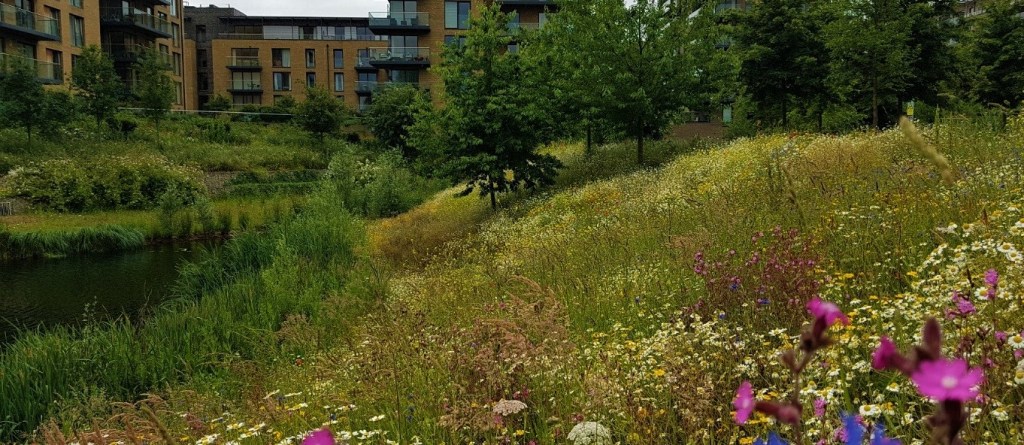
The UK government has committed itself to reversing the loss in biodiversity across the country by 2030 and has made provision in its “flagship” Environment Act 2021 for ensuring that each future development project delivers a 10% gain in biodiversity on its patch. It is expected that this requirement will be mandated through the Town and Country Planning Act by 2023, although it is hoped that “best-practice” developers and planners will adopt it sooner. Given that almost all development projects destroy and make significant changes to habitats within the area around them, this requirement will require very close co-operation between architects, developers, planners, site operators or managers and ecologists to achieve the new biodiversity requirements. Development plans will be judged against established principles for improving biodiversity.
If you need ecological advice on achieving a biodiversity net gain within your project, then contact us.
BNG Principles
Development projects will be required to avoid losses or damage to irreplaceable eco-systems. An example of such a system is ancient woodland, where rare plants or creatures thrive. Such habitats take hundreds of years to establish, and new woodlands cannot provide appropriate conditions for the rare species to be transferred to. For example, colonies of extremely rare wild honey bees and Barbastelle bats have recently been discovered in Oxfordshire and Norfolk respectively, and their habitat requirements mean that they cannot be transferred to other locations in mitigation of any future development project.
Application of the “mitigation hierarchy” requires planners to do everything possible to avoid and then to minimise impacts on biodiversity within the development site. As a last resort, and in agreement with planning authorities, compensation must be made for losses that cannot be avoided. Finally, if compensating for losses within the development footprint is not possible, or does not generate the most benefits for nature conservation, then biodiversity losses must be offset by gains elsewhere.
The proposed gains must be measurable and clearly in excess of what would have happened had the development not taken place or what would have naturally been achieved without intervention. They must also achieve the best outcome for biodiversity within the local area as well as contributing to regional and national aims. In addition, plans will have to include interim measures to be adopted whilst the longer-term changes take effect or develop. Furthermore, the gains must be sustainable and have funded management and contingency plans as well as being resilient to external changes.
Clearly, the above requirements will require commitment from all the interested parties and good communication, especially when changes to plans might be required, to achieve the aim of preserving and improving biodiversity as well as successfully completing the development project. However, if we fail, not only will we will remain at the bottom of the world league but we will all suffer the economic and well-being problems that biodiversity decline will deliver.
For more detail on BNG Principles refer to the guidelines approved jointly by CIRIA, CIEEM and IEMA.
 JP Ecological Services