
The principal purpose of completing ecological surveys related to development projects is to demonstrate clearly to planning authorities that the proposed work will take appropriate account of the need to protect habitats and species which might be affected. Initial plans may then be modified, and mitigation measures employed, where necessary, to prevent or minimise damage to protected species, whilst management plans may be prepared in accordance with Local Nature Recovery Action Plans and to ensure nature and biodiversity recover and are even improved following completion.
Generally, nature doesn’t work to our timetables, but local authority ecologists/biodiversity officers will expect that surveys will have been conducted at the optimum time for the subject species; for example, there is no value in surveying for dormice, great-crested newts or reptiles in the winter months, when they are almost certainly hibernating, because the results will not be a true reflection of reality. Similarly, it is much more reliable to determine habitat types through their vegetation cover during the spring and summer months, when foliage is abundant and flowers and fruits are present. So, when are the best times to undertake the various types of ecological survey?
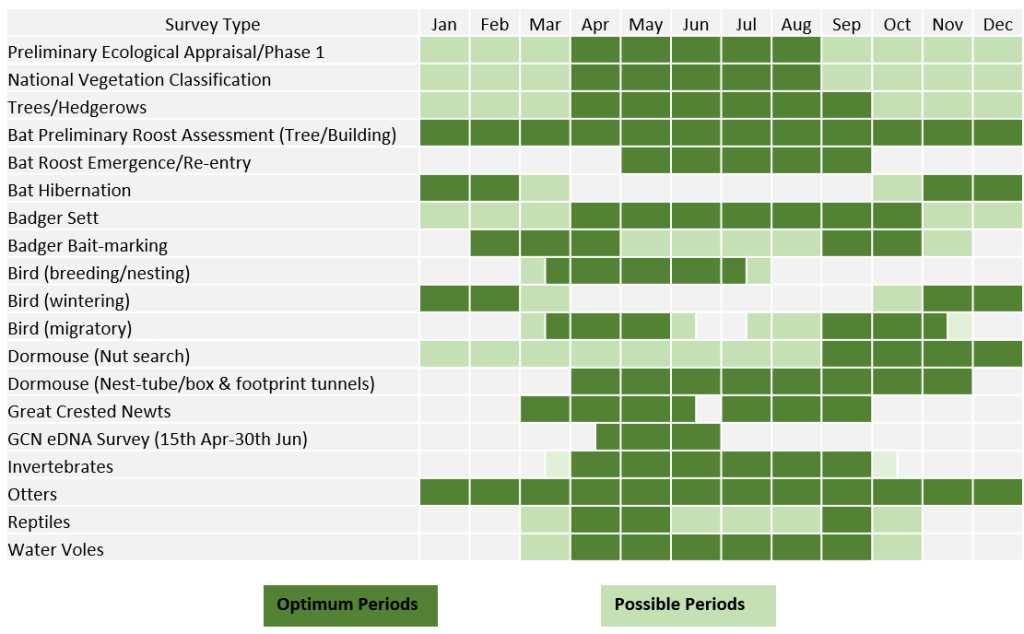
Our Table above attempts to identify the most appropriate times for the completion of different types of survey. The optimum periods are highlighted in dark green, whilst other periods, highlighted in light green, might be appropriate if weather and other conditions are favourable.
However, the Table doesn’t present the whole story, because the survey techniques for some species requires the planning and installation of devices such as refugia panels, nest tubes or IR cameras, before the actual surveys can commence. The installations must then be followed by a series of examinations, often over a period of weeks or months, to determine whether the area is being used by the subject species or not. If these devices are not installed appropriately, then the survey period will be shortened and may not be sufficient to ensure the results are valid, probably leading to a need to repeat the survey the following year and delaying the project implementation.
If you need help in planning your ecological surveys, then do not hesitate to contact us.
 JP Ecological Services
2 thoughts on “Ecological Survey Calendar”