
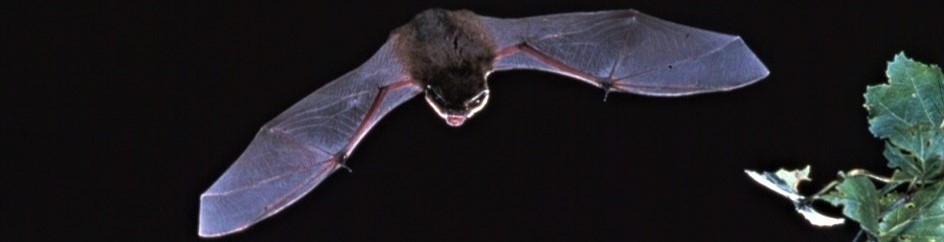
The need for bat surveys often arises from the redevelopment of buildings, although it might also come from a project on land where there are potential bat roosts within older trees on or around the site. Surveys might take the form of Preliminary Roost Surveys or Hibernation Roost Surveys and Emergence and Re-entry Surveys. This article outlines some of projects we have assisted with, in conjunction with Spectrum Ecology. If you need assistance with bat surveys, then please contact us.
Disused Chapel. One of our recent Preliminary Roost Surveys was conducted on a disused chapel, along with its associated community hall, on the edge of a small village in south Wales. Local people had reported that bats had been using the structures when the chapel was active some years ago, and the local ecological record checks suggested that bats were still being seen in the neighbourhood. However, the buildings were now in a very poor state; the roof of the chapel had collapsed into the building and the top sections of the walls were crumbling, whilst the community hall had also suffered significant deterioration to its roof and walls in places. The owners were looking to pull the remaining structures down before building a new property, hopefully using some of the stone reclaimed from the chapel. Our visual inspections were restricted by the poor state of the buildings, but no traces of current or recent occupation by bats were found during the checks of the roof voids or cracks and crevices that were accessible, although one highly degraded bat dropping was found in a side room of the hall building. Our checks also suggested that there were now very few, if any, locations with the building suited to open-roost species, leaving only the possibility that crevice dwellers might be able to use some parts of the remaining structures. Because the roost survey was completed within the generally accepted bat-hibernation period, however, we were unable to undertake any emergence or re-entry surveys to confirm that bats had abandoned the property. We recommended that emergence/re-entry surveys be conducted once bats emerge from hibernation and also provided some advice on precautions and mitigation measures to be adopted should the project go ahead.
Country Pub. Another Preliminary Roost Survey was conducted on a large, countryside public house and restaurant complex which had been closed because of the Covid pandemic, and which was not going to be re-opened for business as the restrictions eased. A bid had been made to purchase the property for redevelopment. The exterior of the building was in excellent condition, with only a few potential access holes and cracks in the facings and eaves which were examined using an endoscope probe; although a bird’s nest was found in one, there were no signs of bats having made use of these potential entrances. It was noteworthy that there were a large number of wall-mounted, roof-level, motion-activated security lights installed around the building exterior and that the smoking area and beer gardens also had large numbers of external lights all of which would deter bats from visiting the area. Internally, we managed to access all areas of the roof void, where only historic traces of activity by mice were detected. Again, we recommended that emergence/re-entry surveys be conducted once bats emerge from hibernation and also provided some advice on precautions and mitigation measures to be adopted should the project go ahead.
Park Café. Plans to extend a popular café in a public park close to the south Wales coast had identified the need for roost and emergence surveys for bats. Although we were not involved in the roost survey, we did assist with some of the emergence surveys. Having established suitable locations from which to monitor the café roof, and equipped with bat detectors of various types, we identified pipistrelle bats leaving their roost at dusk and were treated to witnessing small swarms of bats fluttering around the roof area before departing for their feeding grounds. Our evidence was added to that gained from the roost survey to inform modifications to the refurbishment plan.
We have also checked potential development sites and other areas for the presence of bats foraging or commuting using hedgerows or tree lines.
 JP Ecological Services