
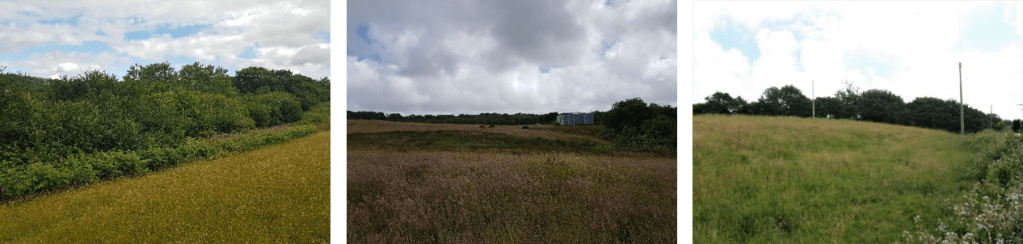
Our work on a site just outside Llanharan, south Wales, commenced as a Phase 1 Habitat survey and hedgerow assessment, in preparation for an application to be included in the Local Development Plan, but was extended to complete an assessment of the ecological importance of the site, threats and mitigations (EcIA). This work might form the basis for an Environmental Impact Assessment (EIA) if needed in the future.
The area comprised 5 relatively species-poor fields, being used to graze a small herd of cattle, although there was evidence of supplemental wildflower seeding in some parts, along with several small areas of marshy grassland within natural depressions and a number of small patches of unmanaged woodland. The site was clearly surrounded and divided by historic hedgerows, but many of these had succeeded to lines of trees or small areas of woodland, whilst the remaining hedgerows were no longer stock-proof. The ground rose gently to the east to a ridge running NE-SW with some areas of excavation and several vents installed along its top, suggesting that historic land uses of this area had included mining, quarrying or tipping. A small number of farm buildings in relatively poor states of repair were being used to house material in support of the cattle and could offer housing to barn owl and bats.
The habitats recorded included semi-improved grassland, marshy and acid grasslands, scrub, hedgerows, broadleaf woodland, running water and swamp. Small areas of invasive non-native species were also found.
Following completion of the initial survey, it was decided to complete a full assessment of the ecological value of the potential development site, because of the proximity to the SINC in the south, 5 SACs within 15km, linkages to nearby woodlands through canopy closure above the eastern road and the importance of hedgerows for habitat connectivity.
A full analysis of the Local Ecological Records suggested that several amphibian species, including great-crested newt, might use the site for foraging and hibernation, so that a habitat suitability study should be undertaken. Skylark were seen during the surveys and barn owls had been sighted close by, so precautions related to ground-nesting birds were identified and a barn owl survey recommended. Sightings of Marsh Fritillary and High Brown Fritillary butterflies within 2km were included in the local records along with a range of other butterflies and moths, so further studies were required to determine whether the site could support them. Similarly, reptile sightings had been recorded in the local area, although the site was thought to be sub-optimal for their support. Nevertheless, mitigation guidance was given to ensure any casual reptiles would not be damaged during vegetation clearance. Although no signs of dormice were found during this survey, it was likely that the hedges and wooded areas served as linkages between neighbouring dormouse habitats, so a full dormouse presence/absence survey was recommended. Several bat species were included in the LERC, so bat roost surveys would be required on the derelict buildings and woodland areas. Native bluebells were discovered in small hedgerow areas, so a fuller survey was recommended to protect populations of this priority species.
Assessments were completed on the potential impact of habitat loss and fragmentation, changes to hydrology and water levels, pollution by chemicals, sedimentation, noise and vibration and air pollution on the local area. Further investigations into the purpose of the ridge-top vents and the impact they might have on any possible development were also recommended.
Continuation of this project has been complicated, because of uncertainty over the future of other plans to build a road and motorway junction in the local area.
Visit the “Our Work” page to see other case studies and examples of our work. If you think we could help you with your ecological requirements, please contact us.
 JP Ecological Services