
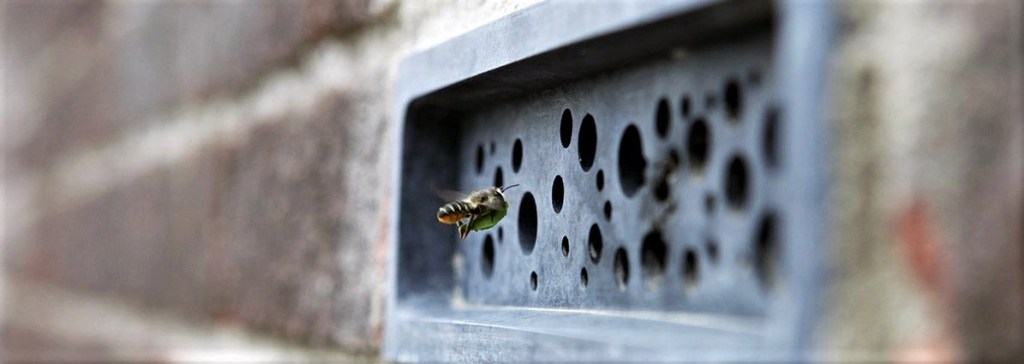
From April 2020, the Brighton and Hove Council has mandated that all new buildings, of height more than 5 metres, must have bee bricks and bird boxes included in their structures. Whilst some have claimed this is a significant victory for biodiversity and a boost for our pollinators, others are concerned that the bee brick requirement might just be “greenwash” or even detrimental to bee populations. So, what “in a nutshell” is behind these differing positions?
Although there are many different species of bee across the UK, many assert that the bee brick will only really be of use to a small proportion of the solitary bees, those who don’t live in collective nests or hives and don’t make their homes in the ground. Members of the mason and leafcutter bee species, all of which are relatively common in England and Wales although rarer in Scotland, are therefore most likely to benefit. However, entomologists point out that for Red Mason bees to adopt a hole for breeding its young, the hole must be:
- More than 1 metre above ground level and unobstructed by vegetation.
- On a sunny and warm south or south-east facing structure.
- Small in diameter and thus quicker to seal, reducing the opportunities for parasitic wasps to access the egg.
- Close to a source of mud, which the mason bee uses to line the hole and form internal walls to separate a number of cells, each of which will contain an egg and supporting food stuffs. Leafcutter bees will similarly choose holes close to suitable plants, such as roses and ash and birch trees.
- Close to plentiful supplies of pollen and nectar from pesticide-free, spring/early summer flowers, because these are used not only to fuel the female bee’s high workload in laying their eggs but also to provide sufficient food for each of the larvae between hatching and its pupa and hibernation stages.
- Free of parasites and not easily accessed by predators.
They go on to observe that if all the conditions can’t be met, then it is extremely unlikely that a bee will make use of the hole; it is thus likely that many of the installed bricks might never be used. Clearly, some conditions can be satisfied during the building construction phase, but the remaining requirements will very much depend on how developers and subsequent building users modify the landscapes around them.
Entomologists also observe that in nature, an individual bee will make use of holes which are isolated from each other as well as from those being used by other insects who also “nest” in holes. There is then less risk that disease and pests will cross-contaminate their nests and that an individual’s whole brood will not be lost in one disaster. The bee bricks, however, encourage “communal” living by a number of species and thus increase the possibilities of predation, parasitism or disease spread.
Some also suggest that whilst bees might make use of the brick holes initially, the accumulation of debris and parasites will mean that they are not suitable in future years, unless the holes are cleaned out after the new adults have left. Furthermore, there is some evidence that if contaminated holes are re-used then most of the young die before emerging as adults. These observations are based largely on studies of bee behaviour related to other readily available forms of “bee hotel”, many of which have been poorly designed, and on well-meaning but inappropriate “home-built” insect homes. Other ecologists, however, suggest that bees are able to clean holes out sufficiently to enable them to be reused.
As with so many things in the natural world at present, there haven’t been many scientific studies undertaken from which to draw firm conclusions. Of course, many would observe that meaningful comparison of breeding successes achieved through the use of bee bricks within a development with those of the undeveloped land would be both time consuming and expensive, if at all possible, and that something needs to be done now. Perhaps, therefore, we have to accept, even in the face of so many negative assertions, that by providing millions of holes, some of them will be in the optimum position from time to time to provide homes to bees and thus compensate for the loss of natural habitat.
If nothing else, though, the Brighton initiative and similar installations should provide opportunities to determine occupation rates and perhaps even to optimise the design and installation of the bricks (eg numbers and sizes of holes per brick, and even the number of bricks and separation distances between them per installation). Like many, we hope that this initiative helps to support solitary bees, but it would be help the adoption of this potential solution if some supporting data on effectiveness could be made available.
 JP Ecological Services