
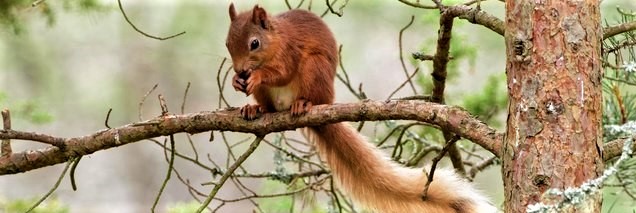
It has been perceived for some time that the recovery of pine marten populations has had a positive effect on the numbers of red squirrels prospering within the UK. The reason is thought to be because pine martens prey preferentially on grey squirrels (alongside voles and other small mammals), thus reducing the number of greys which both compete with red squirrels for food and also carry a disease which is lethal to our native squirrel. However, an important study by Queen’s University Belfast and the University of St Andrews has recently added another dimension to the story, one which is particularly relevant to our policies and actions in respect of reducing the impact of climate change.
The investigation, involving 700 sites over 5 years, demonstrated that in deciduous woods, the pine marten controlled grey squirrels, and that red squirrels were thus able to prosper. This doesn’t come as much of a surprise, because red squirrels and pine martens evolved side by side within our historic mixed broad-leaved woodlands, and our native squirrel has thus had thousands of years to develop strategies to reduce its chances of being eaten. Invasive grey squirrels, on the other hand, haven’t had as much time to adapt, so they currently present an easier challenge to a hungry pine marten, particularly it seems in the squirrel’s breeding season. In deciduous woodlands, therefore, the pine marten is an unwitting ally to the red squirrel through reducing the competition posed by the grey variant.
However, within non-native coniferous plantations, the presence of pine marten meant that red squirrel did not prosper as it did in the deciduous woodlands. This might be due to the red squirrel being the only prey “on offer” in such woodlands, as well as there being a reduced number of refuges available to red squirrels in highly simplified coniferous habitats.
Unfortunately, in many regions, red squirrels have been driven into less than optimum, non-native coniferous woodland, where they have been able to adapt their diet, whereas the grey squirrel hasn’t yet managed to adjust well to this habitat. There is now increasing concern that, as pine marten populations continue to grow, they will make more use of coniferous woodlands, and that our current red squirrel populations will therefore be significantly reduced.
Of equal concern though is that fast-growing coniferous plantations might be preferred to broad-leaved woodlands, as a relatively “quick fix” to carbon sequestration needs, as well as because of their commercial value. Furthermore, new non-native coniferous woodlands are often being justified on their ability to provide habitat for red squirrels. However, the recent study demonstrates that we will, by planting more conifers in our countryside, add to our red squirrels’ woes rather than assisting their recovery.
It seems clear that the return of a native predator has had a significant impact on the invasive grey squirrel, but if we are to improve biodiversity by rebuilding pine marten and red squirrel populations further across the UK, we need to give due consideration to the habitats these animals are best suited to as well. Our focus should therefore be upon improving broad-leaved woodland habitats and not non-native coniferous woods, so that both our native species can prosper.
The project report also highlighted the fact that pine martens do not share our urban habitats and that they cannot therefore act as a control on grey squirrels there. Our red squirrel re-introduction programmes perhaps need to determine another way of controlling grey squirrel numbers here, so that urban areas don’t act as a huge reservoir of animals to repopulate the neighbouring countryside.
 JP Ecological Services