
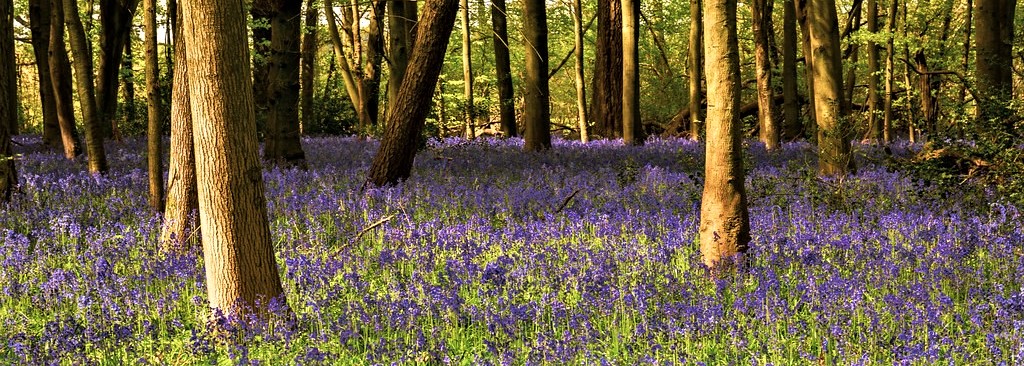
During a recent survey for the presence of badger setts, within and around the boundaries of a potential development project in the south of England, we discovered our first bluebell flowers of the season. Although most had short stems with unopened buds, one or two had wide, light-blue bells, with only slightly-curved tips, arranged around the stems, revealing that they were hybrid or “Spanish” bluebells, rather than our native “English” bluebells. Nevertheless, it was a reminder that some of our woodland areas will soon be festooned with this iconic plant.
“English” bluebells generally thrive in the moist, rich soils of long-established woods, where despite the dappled shade they take advantage of the spring period, before the woodland canopy closes, to take up most of their nutrients. Although they will grow in new woodlands and hedgerows, studies suggest that “our” bluebells aren’t able to spread their seeds very efficiently, so small colonies are able to expand by less than one metre per year without assistance. It is currently estimated that the UK provides a home for more than 50% of the world’s populations of “English” bluebells, with the rest scattered widely across western Europe, so it is important that we look after this species and its preferred habitat of older woodlands carefully, if it isn’t to become extinct. Consequently, we have recommended the inclusion of native bluebells within seed mixes for some of our biodiversity improvement projects where small open woodland areas just need a little management.
The “Spanish” bluebells, introduced to our gardens by the Victorians, were often thought to be the greatest threat to our native species, but a study by the Royal Botanic Garden Edinburgh suggests that our variant remains more abundant, is more tolerant of shade and more fertile than the imported species. Instead, it is now thought that climate change and the loss of older mixed-deciduous woodlands, with their open glades, to development projects are the largest threats to “English” bluebells. Other threats include car exhaust fumes, which encourage the growth of nettles and brambles to swamp the smaller bluebell plants, and the damage inadvertently inflicted by people who crush the leaves whilst admiring the displays.
We are looking forward to this year’s displays of native bluebells and hope that, together with development projects, we can help protect and even expand their habitats to ensure that later generations can also enjoy the marvellous spectacle of carpets of blue in our woodlands.
 JP Ecological Services