

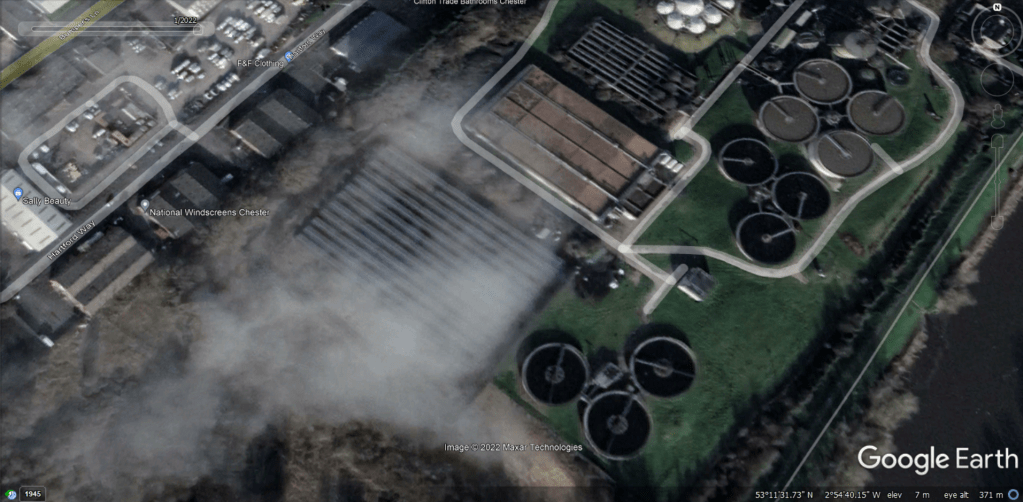
Our 3-year project at this Welsh Water site was in support of a solar-panel array installation to supply the treatment works. There were many badger setts within and around the site, so survey and mitigation work was extensive. A Biodiversity Net Gain design was also prepared and ecological support was provided during some installation phases.
The initial task was to complete an Extended Phase 1 Habitat Survey of the proposed development location, to include a review of earlier surveys completed at the site, whilst providing recommendations and identifying potential mitigations for the project. The project subsequently required a lot of work to protect a clan of badgers which regularly used the site and to preserve access for this protected species into the future. The local planning authority also required a design to improve the biodiversity of the site on completion of the project, so we undertook an assessment and provided a management plan to satisfy this requirement. We also provided on-site ecological supervision of some critical phases of the work to ensure that the client and its contractors didn’t breach legislation or the conditions of the environmental authority’s licence to work.
Untypically, this project was extended by changes in the client’s management team and reviews of project priorities elsewhere across their estate. Nevertheless, the installation has now been completed and “switched on”.
If you would like to see other examples of how we have provided ecological support to other development projects, please see our website’s “Our Work” page. If you need ecological assistance with your project plans, please contact us.
Phase 1 Survey. The habitat was classified principally as tall ruderal, mainly nettle but infested by large quantities of Hemlock and Common Hogweed with several large patches of Giant Hogweed, all of which would need care during clearance. There were also small collections of relatively recently planted trees which had little conservation value and the loss of which would be easily mitigated by the installation of nest boxes in the residual woodland patches. The habitat was considered as unsuitable for most of the protected species identified from the Local Ecological Records Check as having been recorded within 2km of the site, and no evidence of their presence was detected during this or subsequent surveys.
Badger Surveys and Mitigations. The earlier survey reports had identified badger sett locations within and around the proposed site, but dense vegetation prevented the location of one of these, whilst there were no longer any traces of setts at two other locations. Nevertheless, desire lines, push-under points in fences and an old latrine were found suggesting some level of recent badger activity within the area. Later, supervised clearance of vegetation, during which several IR trail cameras were also deployed, revealed 3 more sett entrances and confirmed that the site was regularly being used by badgers entering from other setts to the north and south of the plot.
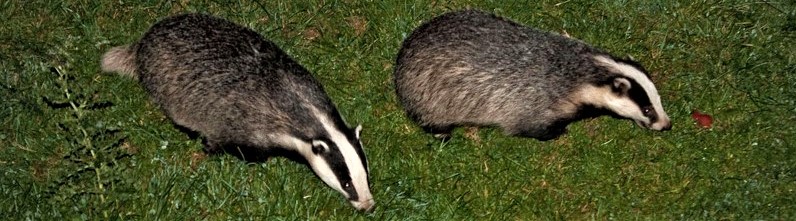
The next phase of our investigations involved the widespread deployment of IR trail cameras and hair traps to monitor sett entrances and entry/exit points, supplemented by a network of bait points which were regularly topped up with treacle-covered peanuts mixed with indigestible coloured plastic pellets. This combination of techniques confirmed that one of the internal setts was being used occasionally, whilst the rest were disused, and that the foraging badgers all originated from the same clan, whose main sett and other well-used annexe setts were outside the development site’s boundaries. We also got some amazing videos of badgers hurdling through a gap which was about 35cm off the ground, in a chain-link fence in order to enter the site.
Evaluation of the techniques to be used to install the solar panels allowed us to conclude that we would have to apply for a temporary closure of the occasionally used sett, but that both it and the foraging area would continue to be useable by badgers after the panel installation had been commissioned. Following detailed applications to Natural England, a temporary sett closure licence was issued. Once we had confirmed there had been no activity in the closed sett, contractors installed security fencing to prevent unauthorised human access to the site, whilst allowing badgers to continue to follow their well-established foraging routes across the area, and completed the outstanding vegetation clearance in preparation for the solar panels.
Biodiversity Net Gain Assessment. The location of the site being in England, despite its operation being undertaken by Welsh Water, required the completion of a Biodiversity Net Gain Assessment of the habitats affected by the development, and the construction of plans to improve the value of the plot by at least 10% on completion of the project. The requirement was achieved through extending existing woodland and scrub areas, just outside the development footprint, to compensate for the patches that were to be replaced by panels, and a management plan to improve the diversity and ecological value of the areas between the panel structures. The plan had to take into account that the ground was extremely nutrient rich, because of the treated sewage deposits in earlier years, in choosing the types of seed and management processes to be adopted to permit a more diverse range of plants to thrive. This plan was accepted without question by the planning authorities, along with the other ecological reports submitted in support of the project, but is due to be reviewed because of changes made to the locations of solar panels and supporting infrastructure as the equipment was installed.
Ecological Clerk of Works Support. The presence of occasionally used badger setts and the scale of use made of the site by local badger clans meant that vegetation clearance and some installation activities needed to be monitored by an ecologist. We supported contractors through pre-work surveys and marking of critical areas, tool-box briefings and advice on the techniques to be used to ensure that badgers weren’t affected by the work and that setts and bird nests were protected where required. We also advised on modifications to prevent rain water from draining from parts of the array into a badger sett entrance. Fortunately, most participants readily complied with the guidance offered, although verbal and written warnings had to be given to a couple of work teams who would otherwise contravened national legislation and the conditions of the environmental authority’s licence to work.
 JP Ecological Services