
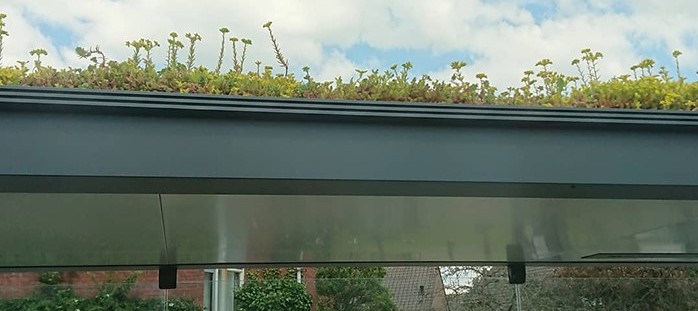
We were happy to discover that the number of local authorities looking at installing bee bus stops in UK cities and towns has increased encouragingly since our last report. A year ago, only a small number of councils were showing an interest, following on from the widespread adoption by Utrecht in The Netherlands, where 316 green-roofed bus shelters had been erected. Today, it seems that councils in many cities, towns and even villages across the length and breadth of the home nations have installed “trial” bee bus shelters, so that Glasgow, Hull, Derby, Halesowen, Leicester, Carmarthen, Milton Keynes, Oxford, Hertford, Hoddesdon, Hemel Hempstead, the University of East Anglia, Bristol, Lewisham, Brighton and Southampton are all amongst those trying to improve conditions for bees and other pollinators in their built-up areas.
Furthermore, companies like Clear Channels have teamed up with Wildlife Trusts across the country to optimise the design of such shelters and currently have plans to install at least 150 bee bus stops by the end of this year. Their design includes 13 native species of wild flowers, along with 5 species of sedum, designed to provide nectar islands around our cities and towns, which could provide welcome oases for our threatened bees. Encouragingly, it seems that Clear Channels also has life-long contracts with some authorities to maintain their bee bus stops at no additional cost to the council. Other bus-stop providers also seem to be offering similar installations.
What isn’t clear at present is how the “trials” are going to be judged as successful or otherwise. With very small numbers of bee bus shelters dotted around the country, it seems very unlikely that observers will detect any significant increase in pollinator populations in the short-term, in particular in the face of other factors, such as weather, which also affect their numbers. However, given that some of the green-roofed shelters will be accompanied by illuminated advertising panels, perhaps the trial is more one of commercial viability. In such cases, let’s hope that these illuminated signs will only operate when people are nearby and not contribute to the ever-increasing light pollution problem.
Inevitably, these bus stops come at a cost, because they have to be able to support the additional weight of earth and plants without danger to shelter users, and the Lewisham and Ludlow studies suggest that bee bus stops cost about twice what a conventional bus shelter costs to install. The cynics amongst us might therefore observe that these “trials” are merely token “green-washing” installations which will appease campaigners in the short-term, but then be dropped once public interest turns to something else. Hopefully though, wider deployment of such shelters will reduce the acquisition costs and that suitable maintenance contracts will minimise or eliminate subsequent weeding and watering costs, so that local authorities won’t be put off the idea.
To be fair, of course, it is possible that the “trials” are merely the first phases of wider deployment plans which must be fitted into already tight budgets for all the services that councils are expected to provide. Hopefully, we will therefore see a rolling programme of new bee bus shelters over the next few years or so.
In an interesting development of the bus-shelter initiative, it seems that Singapore is trialling a scheme where green roofs are fitted to 10 of their buses. The principal reason for this trial is to see whether the green roofs will reduce the need for air-conditioning in these buses, but of course they could provide nectar for visiting bees whilst they aren’t on the move.
Initiatives like the bee bus stop and World Bee Day (20 May) are vital to raise awareness of the plight of declining pollinators. Amazingly, the UK, has around 270 species of bee, primarily solitary bees as well as the better known bumble bees and honey bees, but many people have no idea of this rich diversity that we are in danger of losing. Many of these species have evolved as specialist pollinators more suited to open flat flowers or tubular flowers or the different shapes in between. This means that the decline of some of these specialist species has high impact on populations of the plants they live on.
Added publicity has meant more gardeners and planners are becoming aware that popular horticultural varieties of some flowers are selected cosmetically but may not have sufficient nectar and pollen to really boost pollinator populations. Ironically the wild flowers, which we often regard as weeds, have evolved to attract pollinators and are a rich source of food. Finding some spots in cities to accommodate these ‘weeds’ where they won’t get mown or sprayed could be a perfect solution helping bees and a wide range of native wild flowers.
If you would like advice on similar measures to mitigate against the damage arising from your development project or to improve its impact on biodiversity, please contact us.
 JP Ecological Services