
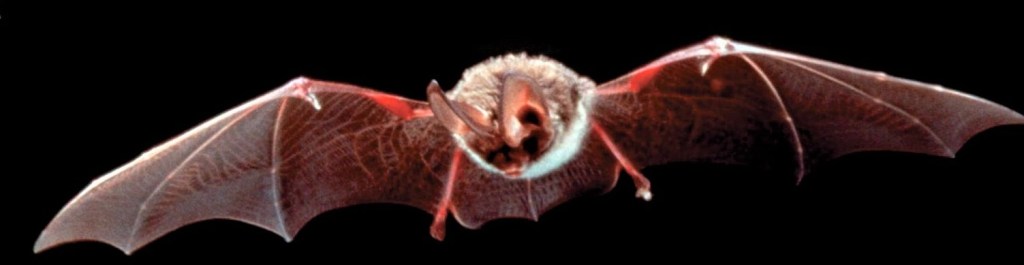
The UK has 18 different species of bat, although some are rarely encountered, and all are protected species. Ecological surveys for the presence of bats will often be required when seeking planning permission for changes to buildings or woodland areas. For information on surveys we have undertaken, see “Our Work”, if you need bat surveys, please contact us.
Key Info
- All UK bats are protected by a variety of laws.
- You could be committing a criminal offence if you:
- Deliberately take, injure or kill a wild bat.
- Intentionally or recklessly disturb a bat in its roost or deliberately disturb a group of bats.
- Damage or destroy a place used by bats for breeding or resting (roosts) even if not occupied at the time.
- Possess or advertise/sell/exchange a bat of a species found in the wild in the EU (dead or alive) or any part of a bat.
- Intentionally or recklessly obstruct access to a bat roost.
- Bat surveys may only be undertaken by licensed ecologists.
Bat Surveys
Bats are generally nocturnal mammals, leaving their roosts around sunset and returning by sunrise, although they hibernate during the winter months. They are most active on nights when the temperature is above 8oC and there is little wind and no rain, when their prey (principally nocturnal insects including moths) is available. Some bat species roost in cavities, cracks and crevices in trees and man-made structures, whilst others use larger, more open, spaces such as roof voids, disused buildings and caves. Surveys for bats come in various forms and each type must be conducted within specific periods of the year.
Preliminary Roost Assessment. These surveys could include (where safe and possible):
- Checks of ecological databases for records of local bat sightings.
- Reports of bat activity from other local sources.
- Identification and measurements of trees to determine likelihood of usage for roosts.
- External inspections of buildings or mature trees to detect potential roost sites or entrances to internal roosts.
- Internal examination of roof voids, disused buildings and structures or other potential roost areas.
- Endoscopic examination of areas which cannot otherwise be accessed.
- Identifying locations which have potential as Hibernation Roosts.
- Identifying precautions and mitigation measures to be adopted during and on completion of the proposed works.
Generally, a Preliminary Roost Assessment must be followed by Roost Emergence/Re-entry Surveys to ensure that both open-roost and cavity-roosting bat species are detected.
Roost Emergence/Re-entry Surveys. These surveys will normally be undertaken around sunset and sunrise, when suitable weather conditions prevail, on up to 4 separate occasions, each separated by a period of 2 weeks, and could include:
- Checks of ecological databases for records of local bat presence.
- Use of bat detectors and recording devices to analyse bat acoustics at pre-planned locations in vicinity of known or potential roost sites.
- IR camera monitoring of roost entry/exit points.
- Visual observations of bat activity.
Generally, a Preliminary Roost Assessment would precede a Roost Emergence/Re-entry Surveys to ensure that both open-roost and cavity-roosting bat species are detected.
Hibernation Roost Surveys. If a structure is considered suitable for hibernating bats, a hibernation survey should be conducted to inform mitigation and compensation. For structures with moderate or high hibernation potential, two inspection surveys should be conducted; one in mid-January and one in mid-February. For complex hibernation roosts, automated/static surveys might need to be undertaken for a minimum of two weeks in each month from December to March.
Our surveys are conducted in accordance with practices and techniques approved by national ecological and nature conservation organisations, environmental agencies and regional ecologists. Currently, our bat surveys are undertaken in conjunction with Spectrum Ecology.
 JP Ecological Services