
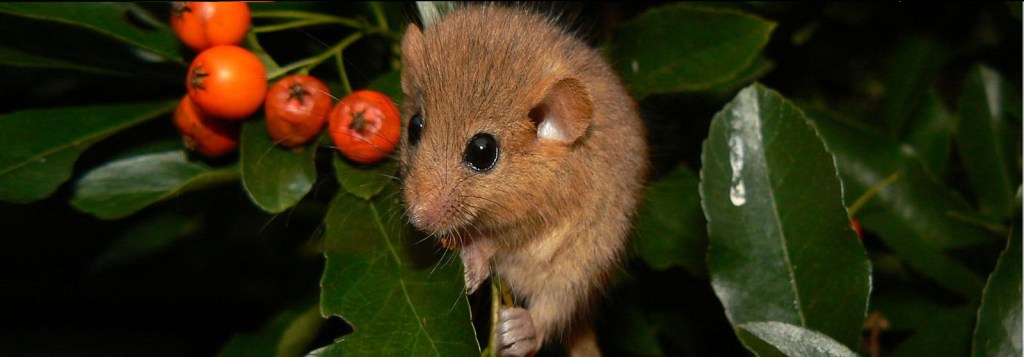
The Hazel dormouse is a protected species, so it and its habitats must be fully considered throughout all phases of development projects. This page outlines what might be involved in surveys and preparing mitigation proposals, whilst examples of how we have assisted project teams at Garnswllt are available elsewhere. If you want to discuss how we might help with your project, please contact us.
Key Info:
- Dormice are a protected species across the UK, and it is against the law to:
- Deliberately capture, injure or kill hazel dormice.
- Damage or destroy a dormouse resting place or breeding site.
- Disturb a hazel dormouse nesting area.
- Block access to a dormouse nesting area.
- Possess, sell, control or transport live or dead hazel dormice, or parts of hazel dormice.
- Dormice may only be handled by licensed individuals, but use of passive survey techniques do not require a licence.
- A range of survey techniques will need to be used in order to conclude that dormice are absent from an area, and these techniques must be rigorously applied to and recorded to support planning applications.
The hazel dormouse is a nocturnal animal that lives mainly in in deciduous woodland and scrub, particularly those with hazel, fruit and/or nut trees, where it feeds and nests (often in old bird nests) among the branches of trees and shrubs. The species hibernates from October to March/April or later if the weather is poor. This behaviour combined with the relatively sparse population means it is uncommon to spot a dormouse even when they are present. As a result, our surveys include habitat assessments, nest-tube surveys and nut surveys. For more information on what these techniques entail, see the explanations below.
Habitat Assessment
This generally begins with desk-based research into historic dormouse populations in and around the area of interest. The researcher will also check whether the proposed development site links to other areas that have, or might support, dormouse populations. Finally, the assessment will include physical evaluations of the size of the habitat area as well as the diversity, distribution, age/maturity of the trees and vegetation.
Nest-tube Surveys
Dormice often build temporary nests in natural crevices or man-made containers like nest boxes or tubes. Nest-tube surveys utilise this tendency to check if there are signs of dormouse habitation, this means installing at least 50 nest tubes at suitable locations within and around the area of study, ideally from mid-February to November. The tubes are then checked once a month from April and November to determine whether they have been visted by Dormice.
Nut Surveys
Nuts are a common food source for dormice and they tend to leave the discarded shells immediately under the trees where the nuts were harvested. Luckily, they also have a distinctive method of opening the nuts which means that shells of nuts consumed by dormice are visually different to those that have been consumed by other rodents. Several locations will be checked for signs in order to determine the presence or absence of dormice.
Survey Outcomes
The combination of the above survey techniques will indicate, to a very high level of confidence, whether dormice are absent from a site. Should signs of dormouse presence be discovered, further advice will be required during the project design phase to prevent harm to the creatures from the proposed work or to identify suitable mitigation actions.
 JP Ecological Services