
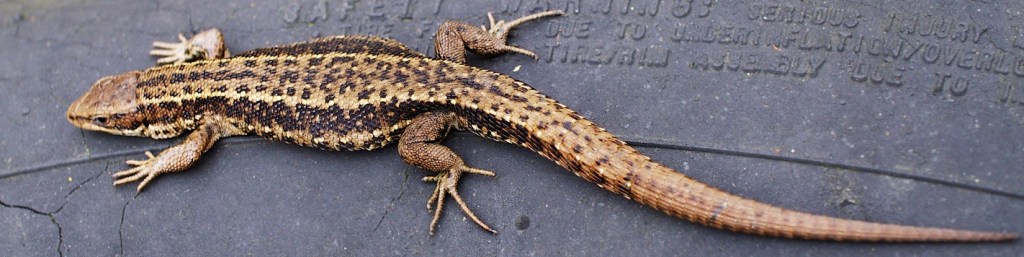
British reptiles are all protected species, so they and their habitats must be fully considered throughout all phases of development projects. This page outlines what might be involved in surveys and preparing mitigation proposals, whilst examples of how we have assisted project teams at Ponthir and Llanilid are available elsewhere. If you want to discuss how we might help with your project, please contact us.
Key Info:
- Sand lizard and Smooth snake are rare animals and are fully protected under the Wildlife and Countryside Act 1981 (as amended) and Conservation of Habitats and Species Regulations 2010, against:
- Deliberate or reckless killing, injuring, or capture.
- Deliberate or reckless disturbance in such a way to be likely to significantly affect: their ability to survive, breed, reproduce, rear or nurture their young – their ability to hibernate or migrate – their local distribution or abundance.
- Deliberate or reckless taking or destruction the eggs.
- Damaging or destroying breeding sites or resting places.
- Intentional or reckless disturbance of sheltering animals, or obstruction of access to their resting places.
- Keeping, transporting, selling or exchanging, or offering for sale or exchange, any live or dead sand lizards or smooth snakes, any part of such an animal, or anything derived from such an animal.
- Adder, Grass snake, Common lizard and Slow worm are protected by means of part of Section 9(1) of the Wildlife & Countryside Act 1981 (as amended) against:
- Intentional killing and injuring .
- Selling, offering or exposing for sale, or having in possession or transporting for the purpose of sale, any live or dead wild animal or any part of, or anything derived from, such an animal.
- Publishing or causing to be published any advertisement likely to be understood as conveying buying or selling, or intending to buy or sell, any of those things.
- Penalties for offences include fines and imprisonment for each offence committed.
- Local Planning Authorities will often ask for a reptile survey to be undertaken as part of planning if the proposed development has the potential to impact on reptiles or their habitats. It should be noted that developments that are not subject to planning permission are still subject to the above legislation.
- Licences are not required to undertake surveys for reptiles other than for Smooth snakes or Sand lizards.
Surveys
Due to their unpredictable and secretive nature, in combination with their highly camouflaged and well adapted behaviours, reptiles are notoriously challenging to observe. In addition, reptiles normally hibernate for the winter, and even in summer their behaviour is closely linked to weather conditions so they are generally detectable only under fairly limited combinations of rainfall, temperature, wind conditions and cloud cover.
We are not currently licensed to undertake surveys for Sand lizard or Smooth snake.
Our reptile surveys might include a combination of:
- Checks of local ecological records within a reasonable distance of the proposed site for sightings of the animals.
- Inspection of the development site and its surrounds for suitable habitats.
- The installation and repeated monitoring of artificial refugia panels – in particular for lizards, slow worms and juvenile grass snakes.
- Repeated direct observation of potential basking spots along a pre-planned route through and around the development site – in particular for all classes of common lizard, adder and adult and sub-adult grass snake.
Survey reports would include the results of the field-work along with recommendations for mitigations to eliminate or reduce the impact of the development project on the reptile population.
Our surveys are conducted in accordance with practices and techniques approved by national ecological and nature conservation organisations, environmental agencies and regional ecologists.
 JP Ecological Services