
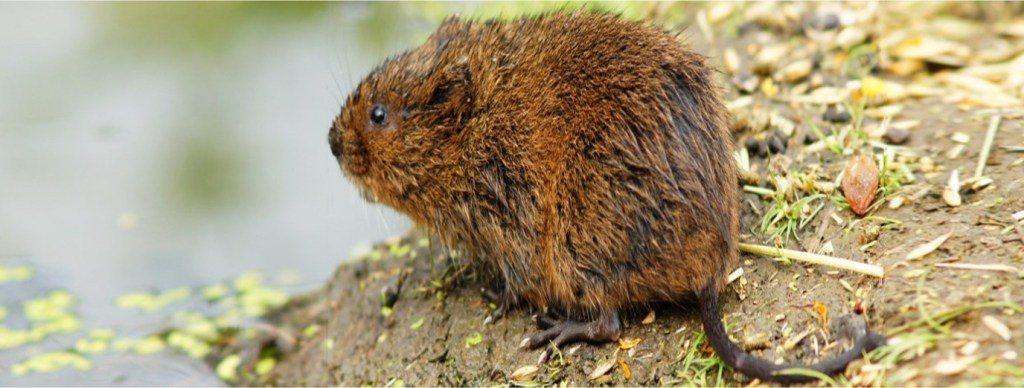
The European water vole is a protected species, so they and their habitats must be fully considered throughout all phases of development projects. This page outlines what might be involved in water vole surveys and preparing mitigation proposals or management plans, whilst examples of how we have assisted project teams at Llanelli and Garnswllt are available elsewhere. If you want to discuss how we might help with your project, please contact us.
- The European water vole (Arvicola amphibious) is listed on Schedule 5 of the Wildlife and Countryside Act 1981 (as amended) making it illegal to:
- Intentionally kill, injure or take wild water vole.
- Intentionally or recklessly damage/destroy a place of shelter/protection.
- Intentionally or recklessly disturb an animal in its place of shelter/protection.
- Intentionally or recklessly obstruct access to its place of shelter/protection.
- Possess (live or dead, including derivatives), sell and offer for sale.
- Water vole are also listed as a Species of Principal Importance (Environment (Wales) Act 2016) and a UK Biodiversity Action Plan Species, meaning that Local Authorities should ensure their protection from the negative impacts of development.
Surveys
Water vole surveys usually involve 2 elements:
- An assessment of the habitat’s potential to support a population of water vole. This requires examination of the hydrological features of the water course, including water depth and flow rate, along with physical features such as surface area of the water course and profile, substrate and floral assemblage/structure of the banks along with any aquatic or marginal vegetation.
- Searching for individuals or field signs to confirm presence/absence. Field signs will include: droppings, latrines, feeding signs, burrows, nests and perhaps tracks and footprints.
Survey reports will give details of the survey work undertaken, advise on the likelihood of water vole making use of your proposed development site and its immediate surrounds and provide advice and guidance on mitigations and management plans to avoid or reduce the impact of the development on these creatures, to help satisfy the requirements of the planning authorities.
Our surveys are conducted in accordance with practices and techniques approved by national ecological and nature conservation organisations, environmental agencies and regional ecologists.
 JP Ecological Services